UW Student Scientists Connect Individual Research with Local Murals
Scientists have long appreciated the arts and used art forms in their practice. And, even though scientists strive for objectivity, they bring their own perspectives and preconceptions to public art, according to a University of Wyoming research scientist.
UW graduate students enrolled in last fall semester’s science communication class, “The Art of Science Communication,” did just that.

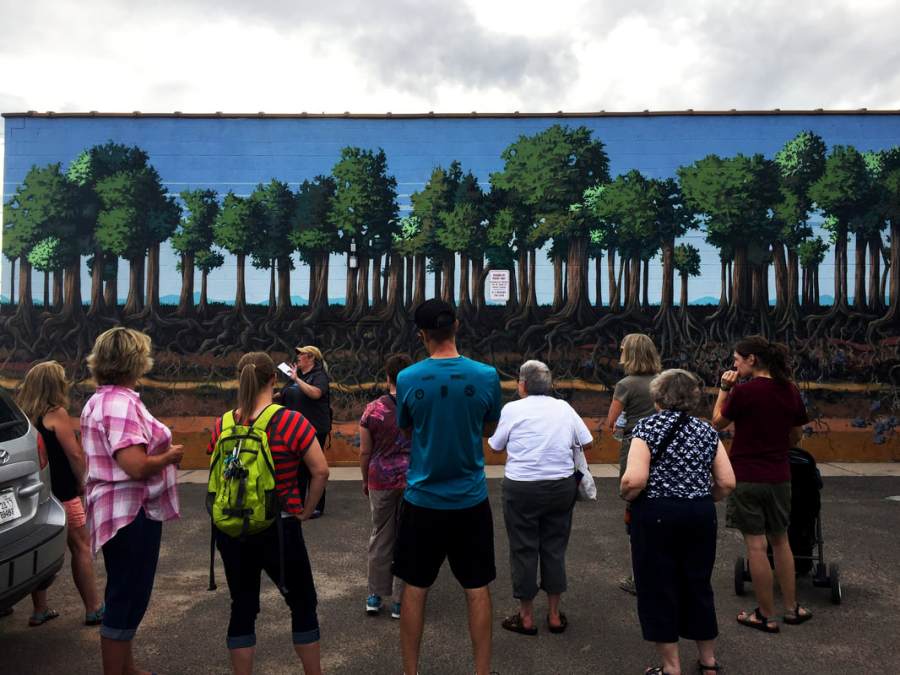
Doctoral candidates — specializing in topics ranging from soil science, birds and bees to black holes, frogs and trees — were tasked with selecting pieces from the seven downtown murals in the Laramie Mural Project and connecting them to their research, says Bethann Garramon Merkle, an associate research scientist with the Wyoming Migration Initiative on the UW campus.
Garramon Merkle, the class’s lead instructor, says, by researching, writing and recording audio guides for a selection of public artworks in downtown Laramie, the students learned how to take their research “beyond science, connecting it with something integral to the Laramie community — our murals.”
To listen to audio recordings of the students’ interpretations of the downtown Laramie murals and public art installations, visit the website at http://engagelaramiescience.weebly.com/listen-now.html.
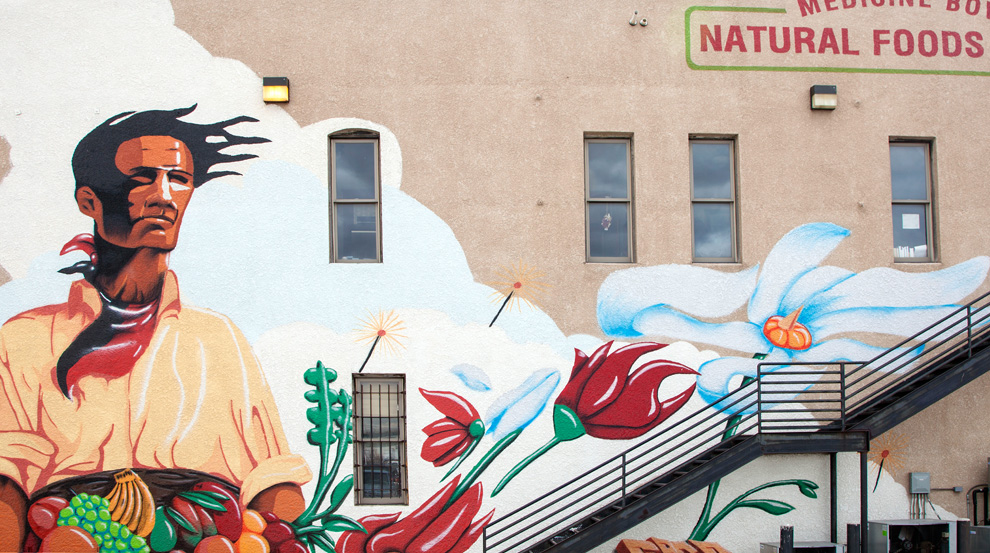
Ecology doctoral candidate Dan Albrecht-Mallinger, from Porter, Ind., studies colorful tropical birds. He focused on the “Tierra y Libertad” on the Big Hollow Food Co-Op mural. His specialty is how and why birds move seeds around in a tropical forest. He tied the birds’ feeding behavior to the cultivation and stewardship evident in mural artist Talal Cockar’s larger-than-life painting of a wind-blown man holding a basket overflowing with produce and flowers.
Albrecht-Mallinger says he was surprised how naturally and instinctively he and his classmates chose their murals and the number of links they identified.
“While none of the associations were likely intended by the artists, I think it’s fun to consider how scientists may perceive and relate to public art,” he says.
Some of the students’ interpretations may seem tenuous or tangential, but Albrecht-Mallinger notes, “Art can work as analogy for our science and the moral motivation of our work. And, some art calls to mind the act of doing science and the consequence of leaving mysteries unsolved.”
Meg Thompson Stanton, Laramie Public Art Coalition coordinator, adds that successful public art can work on a greater scale than solely the artists’ intentions. She helped the UW students prepare their individual audio interpretations. As an artist and public arts coordinator, she asserts that once a piece enters the public sphere, it belongs to the public to engage with and interpret intimately and globally.
“The interpretations that come from public engagement often add layers and meaning to the original piece that the artist probably was intuitively working from, but may not consciously articulate,” she says. “This is where the magic happens. I love this ‘scientists-interpret-murals project’ because it is a beautiful example of that.”
Albrecht-Mallinger agrees.
“I think we all enjoyed the opportunity to look at the art around us and find a bit of ourselves in it,” he says.
In addition to taking part in a fun course project, connecting students’ research to public art enhanced their capacity to think about how individual research relates to daily lives — a critical skill for scientists committed to engaging with the public, Garramon Merkle says.
Other doctoral students in the class were Daniel Beverly, hydrology, from Colorado Springs, Colo.; Chelsea Duball, soil science, Exeter, N.H.; Michelle Mason, physics, focusing on astronomy, Clayton, Calif.; Chris Petranek, ecology, Downers Grove, Ill.; Heather Speckman, ecology, Arvada, Colo.; and Melanie Torres, ecology, Westerly, R.I.
Thanks to collaboration and interest from the Laramie Mural Project, the Laramie Public Art Coalition, and the University of Wyoming Press Office, the student s’ interpretations were highlighted in this January 25, 2018 press release issued by UWyo. Some of the students also authored blog posts providing more insight into their interpretations. Read them here:
 Engage Laramie Science