
|
Hello everyone! My name is Melanie Torres, and I am this blog’s first feature editor. Thank you so much for checking out our collaborative blog about scientists communicating their research to you, the public! I am a transplant to the University of Wyoming from the New England coast, and I am starting my first semester here as a PhD student in Ecology. I cannot express how excited I am to get the ball rolling on this scientific communication venture. |
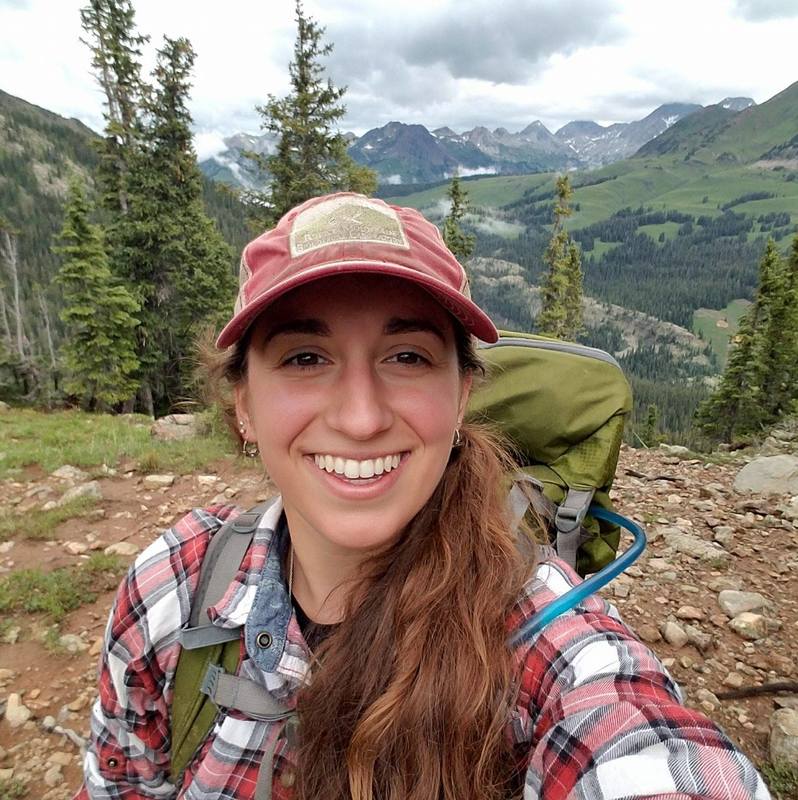
Yours truly at the Mexican Cut Nature Preserve, north of Gothic, CO.
|
 A green frog (Lithobates clamitans) seen during a frog call survey in PA (Image provided by Melanie Torres).
 A metamorphosed Arizona Tiger Salamander, looking a wee bit chubby in CO (Image provided by: Melanie Torres).
I recently defended my MS thesis in Watershed Sciences from Murray State University, where I was working on a model predicting areas where an amphibian-killing fungus, Batrachochytrium dendrobatidis (Bd), could be found in west-central Colorado. For the past four summers, I was based out of the Rocky Mountain Biological Laboratory, where I was primarily working with Bd data from Arizona Tiger Salamanders (Ambystoma mavortium nebulosum, top and right) and the Colorado state-endangered boreal toad (Anaxyrus boreas boreas). For my PhD, I will be studying the range of available resources and ability for amphibians to access those resources across spatial scales.
I decided to improve my scientific communication skills at the start of my PhD because I have been frequently approached and asked about my work. In most cases, people are curious and interested with what I do. However, I have been met with disgust enough times for it to bother me. I think amphibians are incredible, beautiful creatures that are severely misunderstood. Therefore, I want to learn the skills to effectively communicate both my research and how amazing amphibians are to even the greatest skeptic. With the right skill set, I hope to instill a sense of fascination and inspiration to help our semi-aquatic friends to as many people as possible.
Thank you, and please leave comments if you have any questions.
Cheers!!


