“I’ve loved math and science my whole life
and I hope I can share some of that love
with you. I don’t want to tell you, or even
show you, about science and how we
communicate it. I want to involve you. “
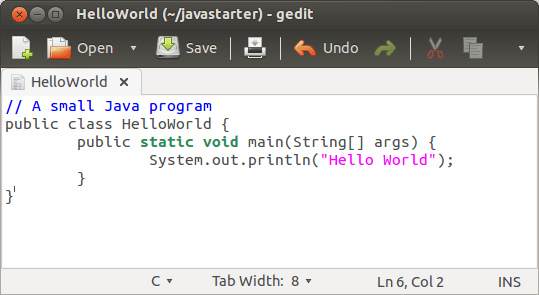
The first procedure we learn to run in coding for astronomy is to print “Hello World” to the terminal window. Pretty much all intro coding classes do this too. Image credit: oracle.com — Java documentation.
Or, in regular English: Hello World! My name is Michelle and I’ll be running our SciComm blog for the next week. I’ve loved math and science my whole life and I hope I can share some of that love with you.
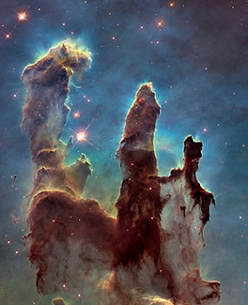
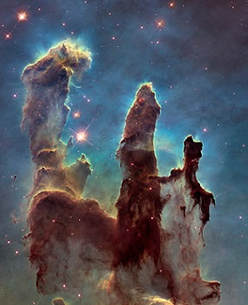 Hubble Space Telescope image of the Pillars of Creation in the Eagle Nebula (2015). Photo credit: NASA & European Space Agency (ESA).
Third grade science class is what really started me off on this journey. We were learning about all nine planets in the Solar System (back before Pluto was demoted), and I decided right then and there that I simply had to learn everything about the Universe. Literally. Everything. Ah, youth… so much energy, ambition, and naivety. But can you really blame me? The Hubble Space Telescope produces the most outstanding pictures of the Universe. Then, to top it off, Contact (the movie) came out, and my fate was sealed. Don’t get me started on the scientific inaccuracies of that movie, but 3rd grader me neither knew nor cared. Space was beautiful and amazing, and I needed to know more.

I landed myself a spot at UC Berkeley (Go Bears!) and graduated with a double major in Astrophysics and Planetary Sciences. As an undergraduate I worked on multiple research projects. From detecting
supernovae to detecting
dark matter, I was always looking to the cosmos for more answers. What I ended up with was more questions, but such is the nature of science.
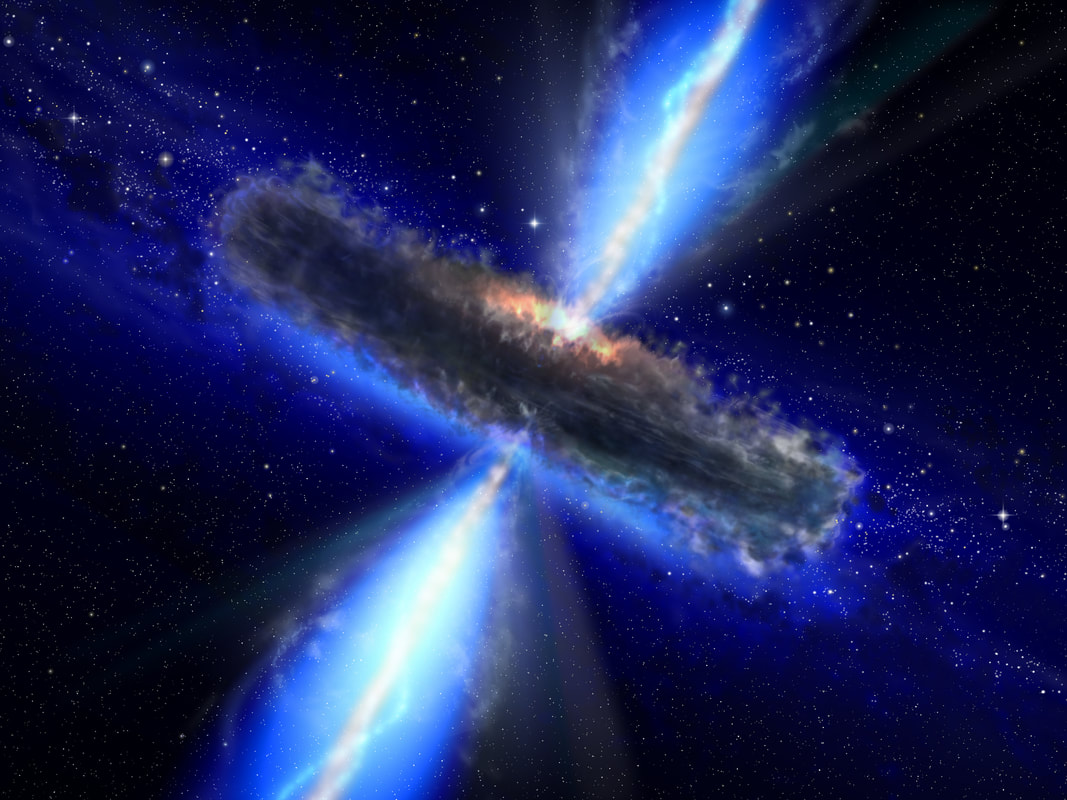
After I left Cal I came to the University of Wyoming to study active galactic nuclei (AGN). Let me tell you, real science pictures of AGN are not nearly as pretty to look at as Hubble pictures of nearby nebulae, although the artist conception images are still beautiful.
Since starting grad school I’ve come to appreciate the importance good educators, particularly science educators. In addition to my PhD in Physics I am now also pursuing a Masters in Science Education. I enrolled in this “Art of Science Communication” class because I believe that effective science communication should go beyond the classroom and into the public.
|
|
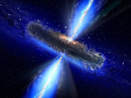
Artist interpretation of AGN. Photo credit: ESA/NASA, the AVO project and Paolo Padovani.
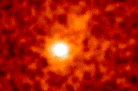
Actual photometric image of a quasar. Photo credit: Astronomy Picture of the Day (APOD).
|
|
For the next week I don’t want to
tell you, or even
show you, about science and how we communicate it. I want to
involve you. I will bring you different
citizen science projects that you can get involved with at home. No experience necessary! It’s never too late to get involved and contribute to scientific findings.
The Universe is so vast and full of unsolved questions that there’s never a bad time to start investigating its mysteries.
“Somewhere, something incredible is waiting to be known.”
— Carl Sagan