
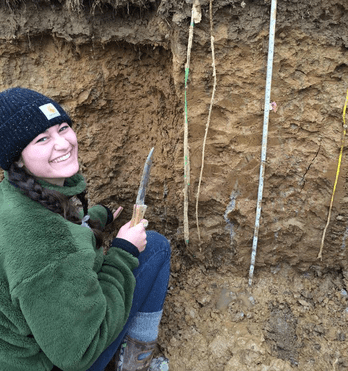
So, let’s begin by digging a bit deeper into who I actually am… For starters, I am a true-blue New Englander, hailing from the riveting 13-miles of coastline, that ACTUALLY EXISTS, in southern New Hampshire.
Here, I grew to love and appreciate the natural world around me – from days spent bird-watching at Great Bay, to after-school tadpole-ing in local wetlands, and even farming in the rocky, sandy soils – I simply could not get enough.
My passions for the outdoors later blossomed into a dedicated effort, aimed towards understanding and conserving these natural resources that are so special to me.
|
The old days spent getting my hands dirty on Barker’s Farm in Stratham, NH (Photo Credit: Chelsea Duball)
|
“Farming from a different perspective”: An oyster farm in Southern Rhode Island, sited in a local salt pond (Photo Credit: Chelsea Duball)
|


These motivations eventually led me to the University of Rhode Island, where I earned my B.S. in Environmental Science and Management, with a minor in soil science, and later an M.S. in Biological and Environmental Sciences, with my thesis research focused on “Environmental Impacts of Oyster Farming”.
Now-a-days you will find me in my first year as a Ph.D. student in soil Science at the University of Wyoming, primarily focusing on establishing a project aimed at the identification and assessment of wetland soils, their ecosystem services, and overall wetland condition.

 The many uses uses and functions of soil (Photo Credit: Kaine Korzekwa)
Although my research has dabbled in the fields of pedology (study of soils in their natural environment), coastal ecology, and wetland ecology, one thing has remained a constant factor through it all – the soil.
While many perceive soils in a strictly agricultural context, my research efforts focus on expanding these perceptions, in order to use soil science as a tool for improving ecological and environmental assessments. Because soil is present everywhere, this also allows for many opportunities to expand soil research worldwide, to novel systems (i.e. oyster farms, marsh restoration sites, mine reclamation sites), in different climate zones, and to initiate new collaborations with a variety of scientific fields (i.e. ecology, water resources, coastal management, geology, anthropology, etc.).
Although I’ve been conducting research for what seems like eons now, in recent years I have found a whole new level of fulfillment through my work – thanks to the wonder of science communication. By delving deeper into the applications of science communication, I have improved my scientific methods, and it has encouraged me to further incorporate creativity into my work, expand my network of audiences, and to conduct research outside traditional scientific means.
Some of my recent SciComm efforts have extended my science and engagement into K-12 classrooms, social media outlets, various non-soil scientific communities, public homeowners and business owners, as well as fellow grad students in other disciplines.
|
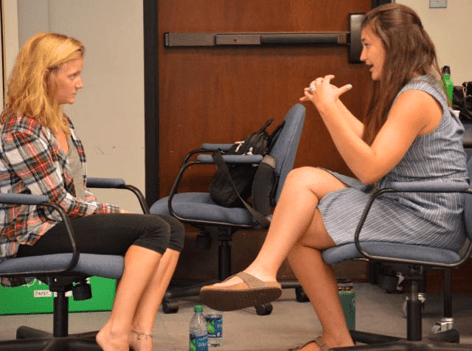
Communicating the story of oyster farming at Stonybrook University’s Alan Alda SciComm workshop, hosted at the University of Rhode Island (Photo Credit: RI EPSCoR)
|
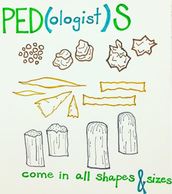
Communicating my science through art on instagram @drawn.from.below
|
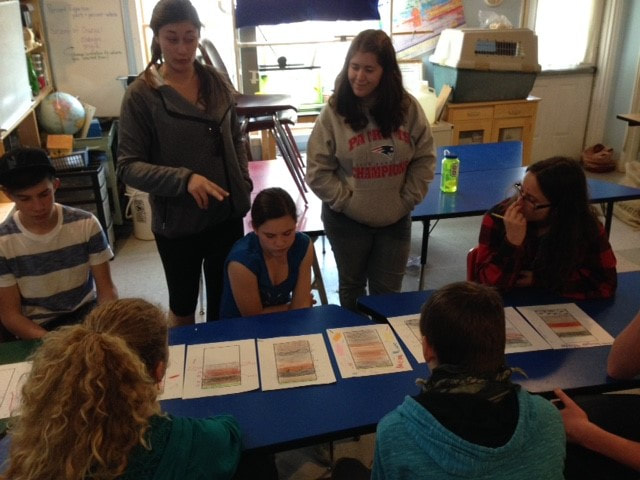
A drawing exercise, engaging middle school students with soil science (Photo Credit: Hilary Fortune)
|
Thanks to recent efforts in my “Art of Science Communication” course, I’m looking forward to expanding my horizons and methods in SciComm. With a wide variety of expertise in our cohort, it also presents unique opportunities for collaborations, which is something of great value.
Though our perceptions may vary on any given piece of work, when we collaborate these unique outlooks together with the use effective communication, it creates great opportunity for interdisciplinary work within this course. For more on interdisciplinary research/work and the effectiveness of collaborations, tune in for my next post!
Soil-Salutations for now,
Chelsea

