
Many species of plants and animals reach the limits of their distributions in the Great Plains of North America, where, in some cases, they are replaced by a closely related species that inhabits the other half of the continent.
The most interesting feature of these contact zones for me is the potential for hybridization between previously isolated taxa. Therefore, I aimed to illustrate some of the bird species that hybridize in the Great Plains.
This figure is aimed at the general public, specifically older students and adults.
When designing this figure, my main consideration was to ensure that the birds in each hybridizing pair are similar enough to be grouped together but different enough to emphasize the fact that they are different (sub)species.
My illustration is highly derivative of the Wall of Birds at the Cornell Lab of Ornithology. This mural is one of my favorite pieces of artwork ever because of the way it samples species to illustrate avian diversity throughout the world.

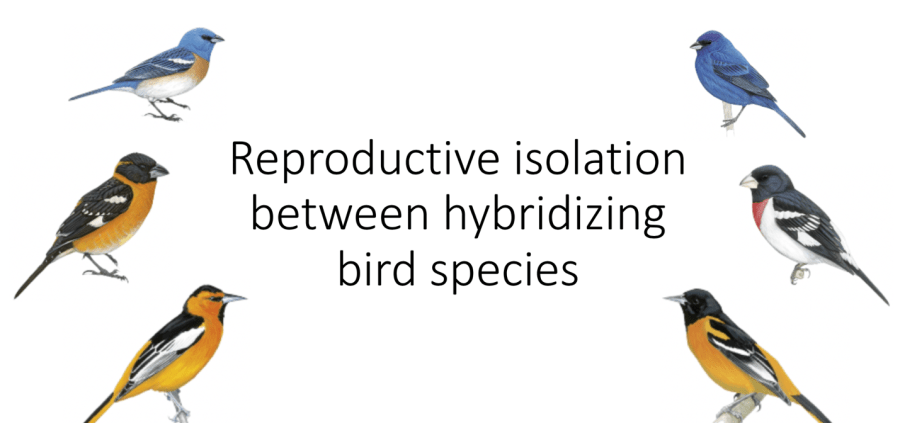
When thinking about how to create a version of this focusing on the Great Plains hybrid zones, I started with the basic design of a title slide from a talk that I recently gave:
|
A title slide from a PowerPoint presentation showing three pairs of bird species that hybridize in the Great Plains, with eastern species on the right (Indigo bunting, Rose-breasted grosbeak, and Baltimore oriole) and western species on the left (Lazuli bunting, Black-headed grosbeak, and Bullock’s oriole). Bird illustrations were originally taken from the Handbook of the Birds of the World Alive.
|
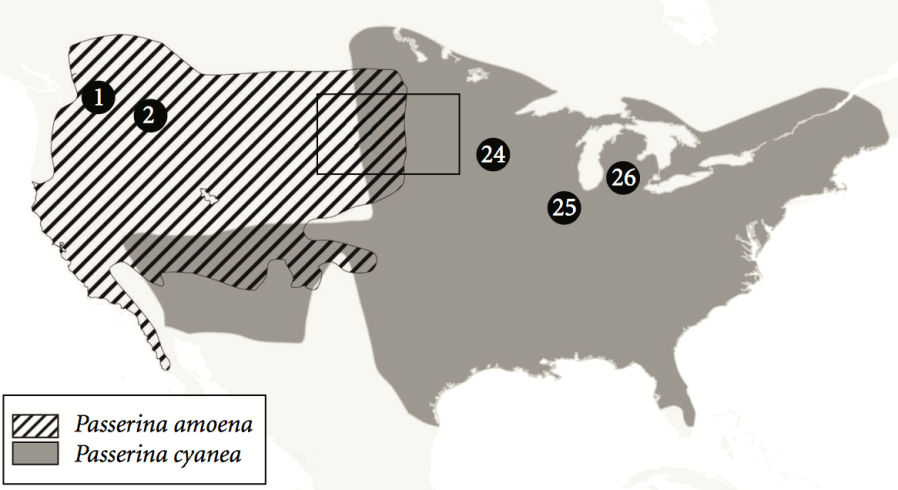
This image, taken from Carling and Thomassen, 2012, illustrates the distributions of Indigo Buntings (Passerina cyanea) in eastern North America and Lazuli Buntings (Passerina amoena) in the west.
|
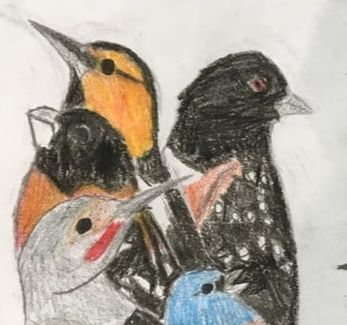
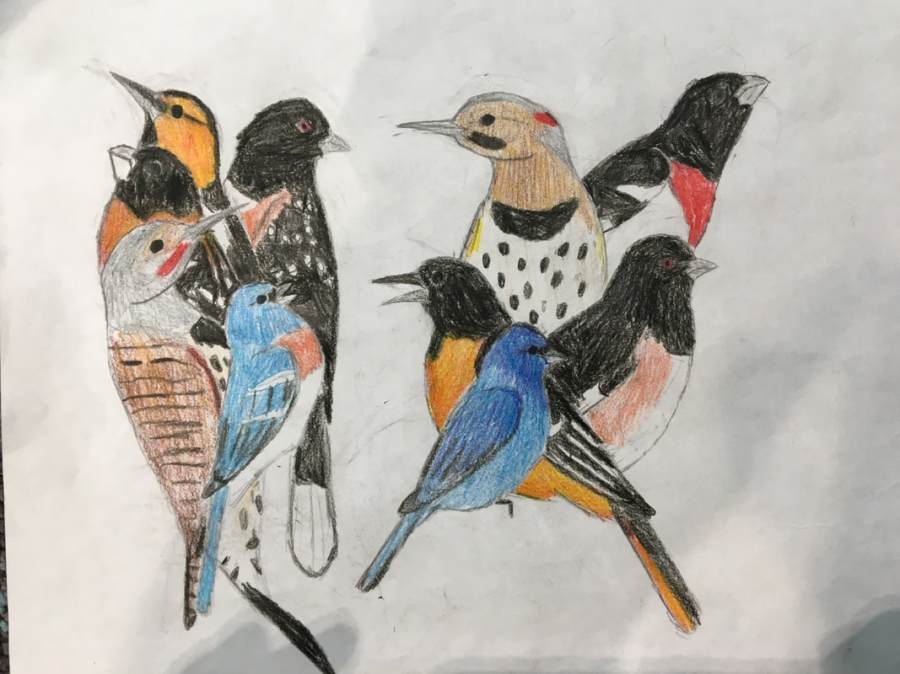
While I really like the way the birds in my illustration (below) are arranged to form the shapes of eastern and western North America, I worry that portraying sister taxa in different poses may make it difficult for viewers to identify who hybridizes with who. Adding labels or explanatory text may solve this issue without necessitating a complete rearrangement of the birds. I may also use GIMP or another digital illustrator to make this image appear cleaner and more professional.
 Engage Laramie Science