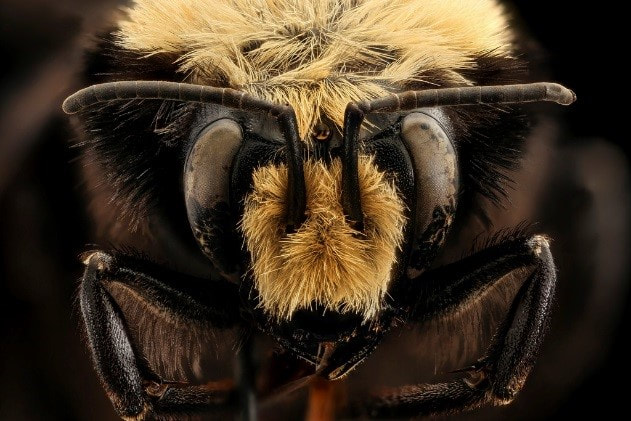

and/or wild honey bees can negatively
impact native bee populations.”
Honey bees originate from Europe and were brought to the Americas in the 17th century. They form huge colony-nests (~40,000 workers) that operate year-round. Colonies can be reared in wooden boxes and transported to wherever pollination services are needed, which makes them so helpful to humans. Typically, they are most useful on lands developed for agriculture where wild pollinators have become scarce.
There is growing evidence that managed and/or wild honey bees can negatively impact native bee populations, mostly by competing for food but also by potentially spreading pathogens (Colla & MacIvor 2017). Native bees such as bumble bees (but also thousands of other species) are of serious conservation concern, and it seems like honey bees are only making it harder for them. And it’s not like the wild bees don’t help us– nearby native bee populations can increase crop fruit set regardless of how many honey bees are already at work (Garibaldi et al. 2013).
The decline of honey bee health nationwide is concerning from an agricultural standpoint, but can hardly be considered a conservation concern. Much of popular bee symbolism and knowledge is related to honey bee biology– it is not a surprise that the honey bee became the flagship species for all things “bee”. However, for the honey bee to represent vulnerable wild bee populations is like having cattle represent the World Wildlife Fund.

Colla SR & MacIvor JS 2017. Questioning public perception, conservation policy, and recovery actions for honeybees in North America. Conservation Biology 31:5 1202-4.
Garibaldi LA et al. 2013. Wild pollinators enhance fruit set of crops regardless of honey bee abundance. Science 340: 6127.
Image sources:
http://all-free-download.com/free-vector/cow.html
 Engage Laramie Science