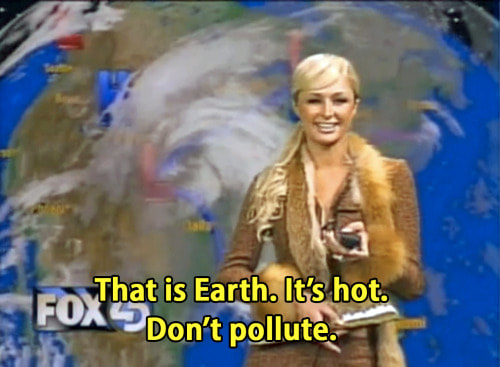
be living in a “post-truth” era.”
For better or worse, carefully curating an internet presence is a key component of any professional career in 2017. This wholesome avocation can range from maintaining a savvy personal website to merely making sure your Facebook profile won’t preclude an interview. Social media outlets are a great way for others to collect information about you, so you may as well use them to your advantage. For most, that means leveraging personality and interesting content to advertise a product or advocate for a desired outcome. If you know the ropes, social media platforms are great for getting your message to reach content consumers worldwide.
Such an inexpensive means for distributing information widely seems especially well suited to scientists seeking to engage the public. To this end, social media can be so effective some scientists are concerned that online presence is overshadowing the importance of quality research. Thus, the “Kardashian Index”, for pitting online communication reach against citation count.
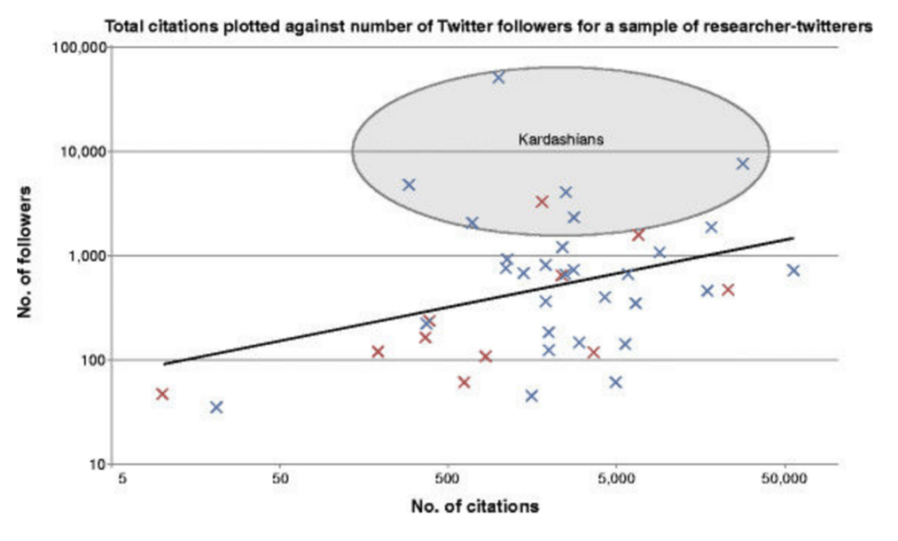
Reassuringly, these preliminary data suggest one’s social media popularity is correlated with their popularity in the scientific community. However, that some scientists’ social media following outstrips their citation count (“Kardashians”) should not imply a lack of credibility. If all scientists were more Kardashian-like in their ability to influence the public, we might not be living in a “post-truth” era.
“Post-truth” refers to the salient observation by nerds nationwide that lay-audiences are not swayed by torrents of numerical observations. There is thus ongoing debate in the scientific community about whether celebrity influencers are useful for communicating science issues broadly via social media. Some say that the ends justify the means, but others are hesitant to have non-specialists speak out about pressing issues in science (Galetti & Costa-Pereira 2017, Mojarad 2017).
While the celebrity approach seems like it could garner the passionate interest in science that we want the public to have, it highlights the general problem: there is a disconnect between scientists and the public. Instead of relying on celebrities to convince the public our work is important and interesting, I think scientists should strive to foster their own positive public image.
There is no shortage of social media pages created by professional researchers (which often have little reach or any connection to a non-specialist audience), nor those clickbait “science” media outlets (which often lack credibility or any connection to practicing scientists). What society does lack is a continuum of popular media outlets ranging in scientific rigor from Science magazine to the National Enquirer.
Some people are interested in scientific nuance, and other people just want to hear about “the cool stuff”. Therefore, I think a robust, positive public image of science can only be achieved in a time when science coverage in popular media spans the entire “scientific method – just the cool stuff continuum”.

Popular science needs to be rigorous or else lose credibility, and fascinating or else lose interest. By populating this continuum with interesting media content, scientists can establish a robust presence in the public eye that accurately represents science. Most of real science may be tedious and detail-oriented, but its presence in popular media need not always be. Likewise, alarming science reports can be misleading if they exceed the science behind them. Whether or not you like the continuum, I bet that someone reading about your research will place your work on it while deciding how interesting it is.
In any case, scientists on social media should always remember the wise words of Paris Hilton: “the only rule is don’t be boring [and dress cute wherever you go]”.
Hall N 2014. The Kardashian index: a measure of discrepant social media profile for scientists. Genome Biology 15:424.
Galetti M & Costa-Pereira R 2017. Scientists need social media influencers. Science 357:6354, 880-881.
Mojarad N 2017. Social media: more scientists needed. Science 357:6358, 1362-63.
Articles used in continuum figure:
https://link.springer.com/article/10.1007/s10592-016-0903-9
https://www.smithsonianmag.com/science-nature/this-insect-has-the-only-mechanical-gears-ever-found-in-nature-6480908/
https://www.popsci.com/science/article/2012-12/spider-builds-fake-spiders-psych-out-predators
http://www.nature.com/news/hawkmoths-zap-bats-with-sonic-blasts-from-their-genitals-1.13333
http://www.iflscience.com/plants-and-animals/hornet-cooked-alive-bees/
 Engage Laramie Science