Post by Ashleigh Pilkerton
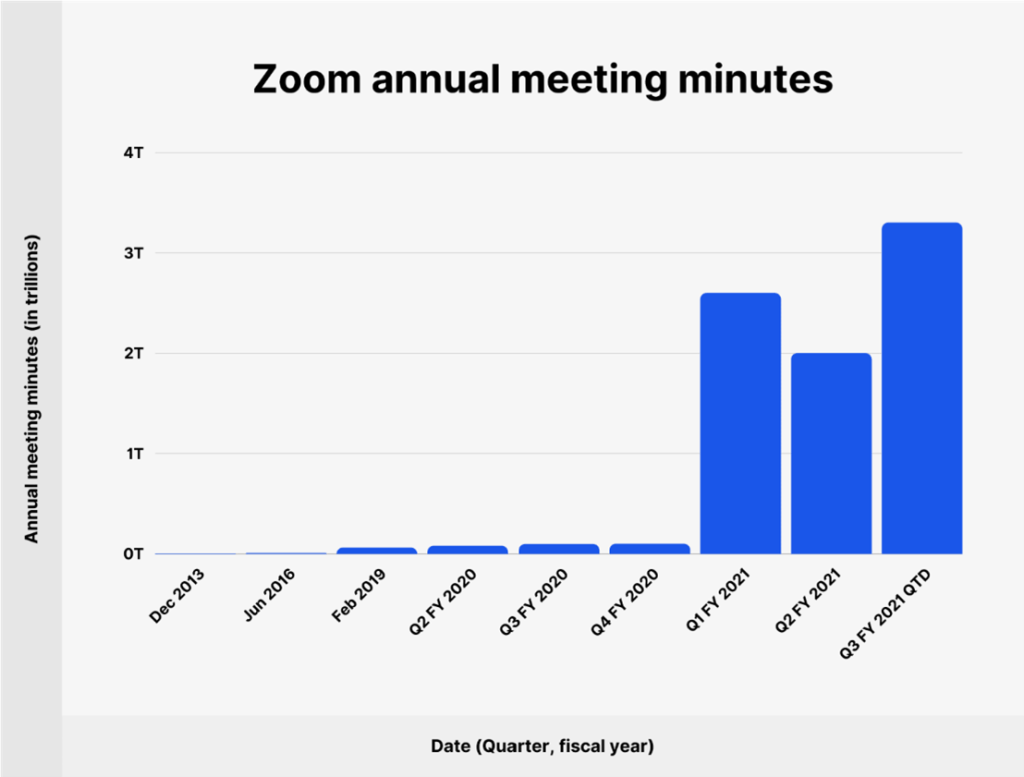
Digital meetings dominated our lives over the past two years with over 3.3 trillion meeting minutes hosted on Zoom during late 2020 (Figure 1, https://backlinko.com/zoom-users), an increase of 3300% since pre-pandemic times. Although it feels like we live more disconnected lives that ever before, the unique opportunity for interaction with experts by large audiences was unprecedented. The transition to an online interaction format allowed individuals from all disciplines to be readily connected and directly engage with leaders in other realms.
In the classroom, alternative course delivery modalities provide flexibility that can enable more students to access education and can attract those with different learning styles or who are looking for a less traditional college experience (Davies et al., 2016). Recorded events provide an avenue of communication between experts and learners in a manner that is less intensive of the expert’s time. One may not have the opportunity to interact with an expert unless they are able to attend pre-scheduled events, travel for meetings or attend professional conferences. However, through the use of recorded events combined with intentional reflection and discussion, the opportunities for interacting with an expert and their disseminated knowledge can be tangible for all.
So what do we do with those terabytes of recorded presentations, conversation, webinars and think sessions? We are presented with a unique opportunity to allow every scientist, thinker, leader and philosopher to serve as the classroom’s “Bill Nye” in a structured, intentional and productive manner. Through deliberate use in the classroom, we can optimize these recordings from peers and experts alike to structure engaging conversations, debates and lessons.
Here, I discuss how I utilized a digital meeting recording and provide a detailed plan and reflections on my experience at the intersection of SciComm and fisheries.
American Fisheries Society SciComm Section Virtual Panel Discussion on “Challenges in Fisheries“
On 26 January 2022, the American Fisheries Society (AFS) Science Communication Section hosted a virtual panel discussion about challenges in fisheries. The American Fisheries Society is the world’s oldest and largest organization dedicated to strengthening the fisheries profession, advancing fisheries science, and conserving fisheries resources. The virtual discussion on challenges in fisheries was initially scheduled to be a session at the annual AFS meeting titled “Beyond the Publication: Science Communication Strategies to Increase the Impact of Your Research” (view recording).
The goal of the session was to “flip the conventional style of talks around to more of a discussion with the audience”, founded in the desire to deviate from the traditional ‘deficit’ model of communication. During this session, each presenter introduced a topic and then used discussion prompts to turn the conversation back to the audience. One goal of the session was to crowdsource solutions to communications problems by creating a more enriching experience for the audience as they hear multiple perspectives and ideas on the solutions. The panel was moderated by Sean Landsman with Dr. Katie O’Reilly, Dr. David Solomon, Nick Kramer and Julie Claussen serving as panelists.
I attended this virtual discussion panel, participated via chat, and subsequently used the virtual session recording to lead a lab meeting where we discussed SciComm in general and took a deep dive into the questions posed by the panelists. First I’ll describe the details of the virtual discussion session, including highlighting the unique delivery and engagement manner implemented by the speakers, then I’ll demonstrate how I optimized this recording and brought it back to my workspace.
The panel moderator, Sean, introduced each speaker and gave an overview of the event, which consisted of 15-minute periods comprised of a 5-minute panelist presentation and 10 minutes for audience discussion. First, Dr. Katie O’Reilly, University of Notre Dame, gave a presentation titled “Communicating controversy, what happens when things go belly up?” in which she detailed the unexpected and negative press received in response to their article published in December 2021 about rough fish conservation. She posed three questions including: “How do you take back control of research narrative?”, “Are there ways to be proactive and address findings that may be controversial?”, and “What strategies can help “turn down the temp” of discourse?”.
Second, Dr. Solomon David, Nicholls State University, introduced ideas associated with his theme of “Garnering respect for America’s “rough fish””. In the flipped dialogue model, he then posed three questions including: “How do we promote the value of native fishes to diverse audiences?”, “How do we increase research support?”, and “What are ways we can encourage sustainable use of the fishery by bow fishers and others?”.
Julie Claussen, the Director of Operations at the Fisheries Conservation Foundation, guided the audience through a thought experiment investigating our personal perspectives and thoughts around water, freshwater fishes and the bias of biodiversity actions on marine fishes. Her presentation titled “Changing perspectives of freshwater ecosystems” was followed by four discussion questions including “Why so little success on communicating the value of freshwater biodiversity?”, “Ways to reach “beyond the choir””, “How can we frame freshwater biodiversity so people feel connected?”, and “Should the messaging change when addressing biodiversity issues for local vs regional vs national vs global level? Is it better to have one unifying message?”.
Last, Nick Kramer, a District Fisheries Biologist at Kansas Department of Wildlife, Parks and Tourism introduced the topic question of “What role to agency scientists serve in SciComm?”. Nick’s presentation detailed the different means that agency employees interact and communicate with the public and opened up discussion on the role social media plays in one’s career. He introduced several discussion questions including: “What are the pros/cons of direct communications? What is the ideal scenario? How would you persuade/convince them of benefits?”, “Is this just an agency problem, or to other universities/nonprofits etc. experience pushback?”, and “Thoughts on social media? What is the role or expectation? What should it be? Where to draw the line?”.
As an audience member, I found the structure of a ‘flipped’ conference session presentation to be more engaging than traditional sessions and very insightful as to how impactful this communication method can be. Each presenter did an excellent job of introducing their topic and posing questions that were both thought provoking and allowed sufficient room for audience speculation, creativity and discussion. I enjoyed the opportunity to hear the thoughts and opinions of other audience members and their experiences dealing with scenarios posed by the panelists. I also found myself more engaged and excited about the material during the session, likely because of the interaction and multiple perspectives I heard compared to a traditional deficit model presentation where I would only interact with one individual (the speaker). Interestingly, I can recall the topics of conversation more clearly and feel I could regurgitate some of the facts today, several weeks, and not months as I finalize this blogpost, after the event, as opposed to my typical experience at conference presentations where I forget the facts within a matter of hours.
This first-hand experience as a participant in the co-production model of science communication has shed new light on the value of being intentional with communication methods. I am excited about the ways I can implement this into my semester project and I look forward to finding creative ways to teach lessons in this style of communication. As I reflect on this event, I also feel like the principles we experienced as participants are paralleling my understanding of ‘inquiry based learning’. I feel more invested in the lesson plan approach of presenting a few moments of background knowledge, followed by allowing students to explore and discuss topics and questions on their own, before bringing it back to the larger group.
Last, I feel this panel discussion demonstrated that it is possible to implement other styles communication beyond the deficit model in academia. With the exception of a few courses that were inquiry based, every single upper division course required for my majors during my undergraduate tenure were based on the deficit model. Although I am the type of student who learns well by taking notes during lecture and reading a textbook independently, I acknowledge that most students do not learn best this way. In turn, attending this session demonstrated to me that we can and should integrate other models of communication into our courses, lessons, outreach events, etc. and can still effectively convey the information we set out to in a meaningful, and likely, more impactful manner.
Bringing the AFS SciComm Discussion to Graduate Student Lab Meeting
After attending the AFS SciComm event, I was inspired to lead a lab meeting using the recorded virtual panel discussion. I invited several other graduate students within the fisheries discipline to attend. After an initial introduction to the goal of the lab meeting, my colleague and I introduced the three main models of science communication. I then went on to explain the format of the presentations by each panelist and had attendees rank their level of interest in each presentation. After identifying the top two ranked presentations, we spent approximately 20 minutes of focused discussion on each. I started by introducing the panelist’s background before asking attendees to independently watch the relevant video segment. Upon returning to the larger group for discussion, I asked for people’s initial reactions to the panelist’s presentation and then prompted further discussion with questions posed by both the AFS SciComm panelists and myself.
I really enjoyed the opportunity to lead this discussion within my lab group and hear their perspectives on both the format of the panel discussion and the topics that were posed. Interestingly, my lab group previously read and discussed one of the speaker’s co-authored papers, which she addressed in her talk (Rypel et al. 2021), which allowed for deeper and more intriguing conversation. I believe I did a good job moderating the discussions and practiced fostering opportunities for my lab mates to drive the direction of the discussion, although I intentionally asked direct questions to lab members who I felt did not speak up as much as others. I also found it enjoyable to develop a guided activity around the SciComm event that I, myself, had participated in.
As with many things in life, I learned several valuable lessons with an overarching theme of ‘there will be technology problems’. First, I used Google Forms to have each attendee rank their interest in the panelist’s presentations. Those not signed into a Google account were not able to rank the titles so I asked them to do so via Zoom chat. That did not go particularly smooth either as they misinterpreted the task; I take full responsibility of that miscommunication and we eventually reached a resolution, however the simple task of completing a form that I thought would take 30 seconds, ended up being a 3 -5 minute saga. In a more traditional classroom, this could have been circumvented by having students simply raise their hand to vote for their sections of interest.
All in all, this was my first time utilizing virtual recordings in an engaging and immersive manner and I can confidently say I would do this again. While my experiences demonstrate one potential way to actively participate with a recorded webinar, I acknowledge there are multiple capacities in which this can be implemented. Sharing snippets of a talk, or key quotes may be transformative for complimenting basic lesson plans; alternatively, pair-share activities with each group assigned a specific section may allow for more breadth in the material accessed while also integrating collaborative lessons. Further, broadly considering philosophical lecture series for developing critical thinking and analysis skills with in the STEM disciplines could serve as a useful substitute for a dry lecture in introductory science courses. Although we may be out of the Zoomiverse of 2020, virtual meetings are here to stay and will continue to provide a valuable and more accessible resource for many. I hope we make the most of these resources to better the education of ourselves and those around us.
Ashleigh Pilkerton is a graduate student in the Program in Ecology and Evolution and Department of Zoology and Physiology at the University of Wyoming.
references:
Davies, T. L., Cotton, V. K., & Korte, L. (2016). Student Usage And Perceptions Of The Value Of Recorded Lectures In A Traditional Face-To-Face (F2F) Class. Journal of College Teaching & Learning (TLC), 13(3), 85–94. https://doi.org/10.19030/tlc.v13i3.9714
Dean, B. “Zoom User Stats: How Many People Use Zoom in 2022?” Backlinko, 6 Jan. 2022, https://backlinko.com/zoom-users.
A.L. Rypel, C.C. Vaughn, L. Nesper, K. O’Reilly, C.A. Parisek, M.L. Miller, P.B. Moyle, N.A. Fangue, M. Bell- Tilcock, D. Ayers, S.R. David. 2021. Goodbye to “Rough Fish”: Paradigm Shift in the Conservation of Native Fishes. Fisheries 46(12): https://doi.org/10.1002/fsh.10660.
 Engage Laramie Science