Post by Abegail Olsen
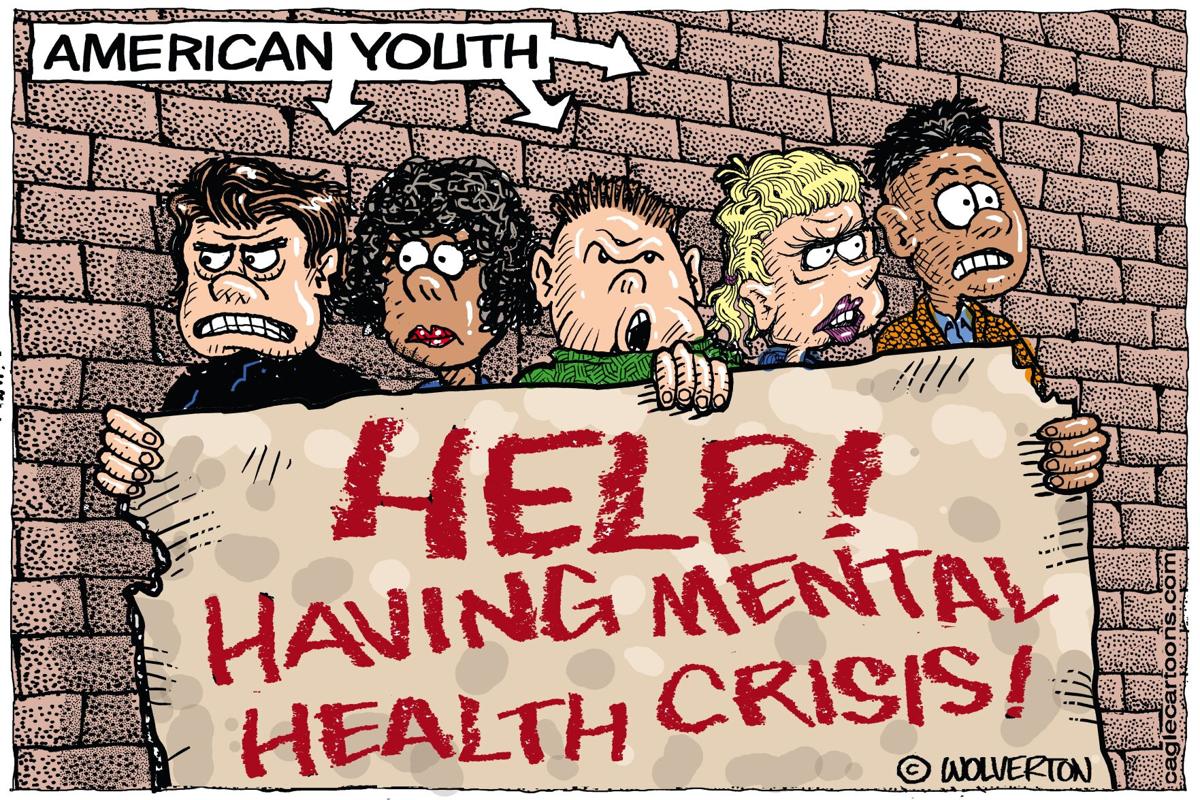
make it easier for the youth to access mental health support? (Image permission from creator M. Wolverton)
I grew up in the giant city of Las Vegas, Nevada. However, within a one mile radius of my house, three youth between the ages of 16 and 22 attempted suicide. These youth were my friends that I grew up with, going to the same schools and church. There were two boys that were successful and one girl that was unsuccessful. The unsuccessful girl is one of my best friends today and I see the struggle she endures mentally everyday with nowhere and no
one to turn to. How do we help the youth with their mental health problems in order to ensure the decrease in suicide attempt numbers?
I have found that youth are hesitant to reach out for help, so I have come up with a way to reach out to the youth. I have created a mental health screening questionnaire designed for the youth ages 15-25 to complete in order for youth leaders to identify mental health needs in the youth earlier. I have communicated with the youth leaders in my church in the Sunrise Manor
area of Las Vegas, and they are open to distributing this screening questionnaire to youth every other week. The youth leaders will take each youth individual one-on-one during class to ask the mental health screening questions and discuss further needs and treatment if needed. This gives the youth two opportunities monthly to seek out help when needed.
I would also like to further my project by furthering the communication and knowledge of mental health issues in my church. I have found that the older generations in the church tend to brush off the idea of mental health issues, and have the “suck it up, and push through” attitude.
Well, mental health issues are a real thing and I plan to communicate this through a short podcast series. One episode will include my friend who attempted suicide. We will be discussing the lack of knowledge of mental health issues in the church, the complications of receiving mental health
support in the church, and what helped her reach out and receive help.
Mental health issues are increasing in youth and young adults, and they need help. I am also an NCAA athlete, and three NCAA athletes have committed suicide in the last seven weeks. The youth need more opportunities to reach out for help. We have to go to them, as more times than not they are embarrassed, do not think to reach out, or think they cannot be helped.
If my project and communication about mental health issues saves just one life, then I will call it a success. This is a small step in the direction of a world where mental health issues are acknowledged and helped.
Abigail Olsen is a senior biology major and volleyball player at the University of Wyoming.
references
References:
Cawthorpe, David. “Improving youth mental health supports in Canada.” CMAJ: Canadian Medical Association journal -journal de l’Association medicale canadienne vol. 190,40 (2018): E1181-E1182. doi:10.1503/cmaj.181233
Lee, H. B., Han, H.-R., Huh, B.-Y., Kim, K. B., & Kim, M. T. (2013). Mental Health Service utilization among Korean elders in Korean churches: Preliminary findings from the memory and aging study of Koreans in Maryland (mask-MD). Aging & Mental Health, 18(1), 102–109. https://doi.org/10.1080/13607863.2013.814099
Rickwood, Debra, et al. “Who Are the Young People Choosing Web-based Mental Health Support? Findings From the Implementation of Australia’s National Web-based Youth Mental Health Service, eheadspace.” JMIR Mental Health, vol. 3, no. 3, 2016. ProQuest, https://www.libproxy.uwyo.edu/login/url=https://www.proquest.com/scholarly-journals/who-are-young-people-choosing-web-basedmental/docview/2516977746/se-2, doi:http://dx.doi.org/10.2196/mental.5988.
Schultz, K., Farmer, S., Harrell, S. et al. Closing the Gap: Increasing Community Mental Health Services in Rural Indiana. Community Ment Health J 57, 684–700 (2021). https://doi-org.libproxy.uwyo.edu/10.1007/s10597-020-00737-x
Trnka, S. (2021). Multi-sited therapeutic assemblages: Virtual and real-life emplacement of Youth Mental Health Support. Social Science & Medicine, 278, 113960. https://doi.org/10.1016/j.socscimed.2021.113960
 Engage Laramie Science