Post by Renee Lile
Knowledge-attitude connections and bat conservation
Bats are an ecologically important animal—suppressing insect populations and pollinating fruits and flowers (1). Unfortunately, bats are also are generally misunderstood and vilified. The disparagement of bats can be partially explained by an individual’s general lack of knowledge about bats. There is a link between knowledge and attitude toward typically uncharismatic animals, with less knowledge correlating with more negative attitudes shown toward an animal (2). In general, children have been shown to hold negative perceptions about bats, and generally lack basic knowledge in regards to bat ecology (2, 3). However, research on 10-16 year-olds in Slovakia suggested that as knowledge about bat ecology and ecosystem services increased, children’s attitudes towards bats became more positive (2). This knowledge-attitude link indicates that elementary education focused on bats can lead to an increase in general knowledge on bat ecology while also improving public attitudes towards bats.
Developing a conservation biology STEM initiative in bat ecology may also improve parents’ perceptions of bat conservation. Recent studies on climate change attitudes indicates that children enrolled climate change education have a positive impact on changing climate change concerns of their parents, and may even help promote mitigation behaviors among parents (4). Children’s education can help change adult’s concern-levels and behavior patterns related to climate change through intergenerational learning (IGL; the transfer of knowledge from child-to-parent). Informal elementary bat-centric education can utilize IGL, giving children the knowledge and tools to share their excitement and passion for bats to their parents or guardians—perhaps helping adults change their negative opinion about bats, and thus creating a community-based shift toward bat appreciation. And yet, the current Wyoming elementary-school curriculum lacks a bat-focused ecology unit (5).
Why Focus on Informal Bat Education in Wyoming?
Wyoming’s public school curriculum does not require wildlife-based ecology units at an elementary-school level (5). While students may get some information on native Wyoming wildlife, it is unlikely that a significant portion of classroom learning will be dedicated to bat ecology. Normally, informal education programs could fill-in these knowledge gaps and provide elementary students with a deep-dive into bat ecology. However, Wyoming also lacks afterschool programing and informal STEM initiatives focused on bat ecology. This does not mean that parents in Wyoming are opposed to afterschool SEM initiatives. In fact, 80% of Wyoming parents support afterschool programming, but many areas may simply lack resources to host STEM programs to deploy at their afterschool programs (6).
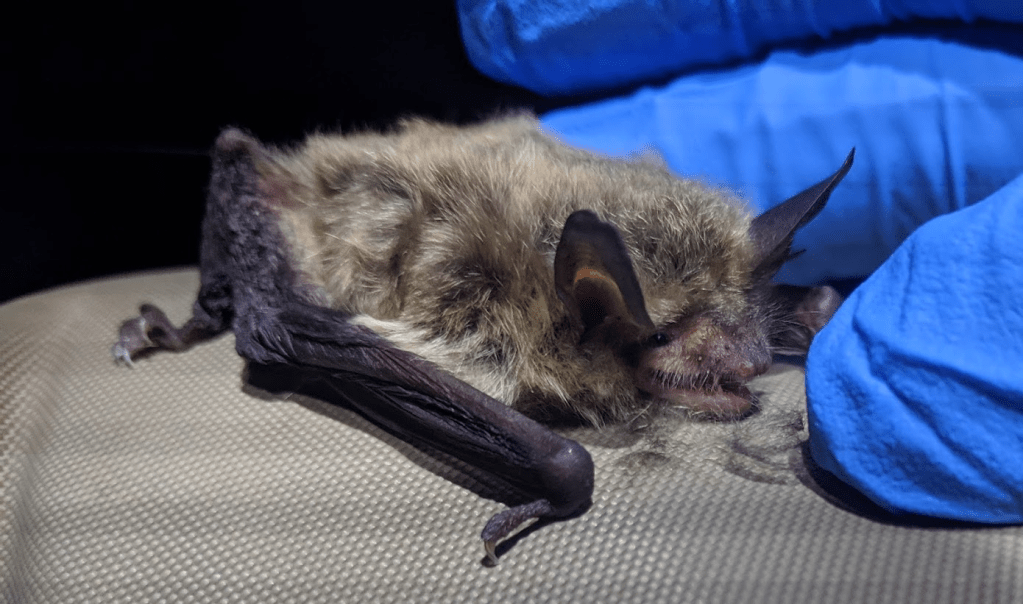
Informal bat-centric education also relates to the larger issues of bat conservation in the Wyoming. Wyoming is home to eighteen different species of bats, including several federally-listed species like the northern long-eared bat (Myotis septentrionalis; see Figure 1) and the tricolored bat (Perimyotis subflavus). Wyoming bat populations face threats from both white-nose syndrome (WNS), which was confirmed in the state in 2021(7), and wind turbine expansion within the state. The threat to Wyoming’s native bat population should concern the Wyoming public, as bats provide important ecological services to our state (1). Unfortunately, adults in our region hold little general knowledge about bat ecology (8). As discussed earlier, negative perceptions (generated due to a general lack of knowledge) about bats can lead to mismanagement and potential abuse of these environmentally significant creatures, further threatening bats in the state. Wyoming’s lack of afterschool informal STEM education, current threats to Wyoming native bats, and the general lack of knowledge/understanding of bat ecology indicates a need for a new bat-centric informal lesson program in the state.
Bat-in-a-Box Informal Education Activity Boxes
To address the lack of informal afterschool ecology programs, threats to Wyoming’s native bat species, and the general lack of knowledge surrounding bat ecology in the state, I wanted to create a “science-in-a-box” activity basket for informal educators to integrate into their afterschool STEM initiatives. To accomplish this goal, I teamed up with the University of Wyoming’s Science Initiative, the Bernard Lab, and the Albany County Public Library to develop an informal education lesson plan that provide the children of Laramie with hands-on bat ecology programs. The purpose of this project is two-fold:
- Improve community knowledge and perceptions of bats;
- Introduce young children to a STEM pathway in ecology.
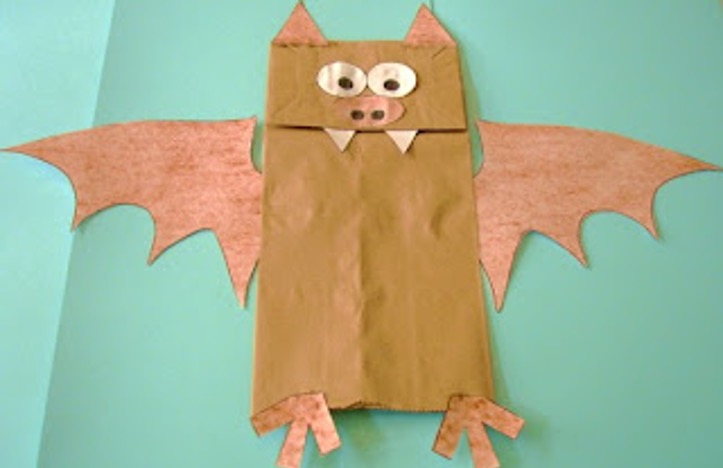
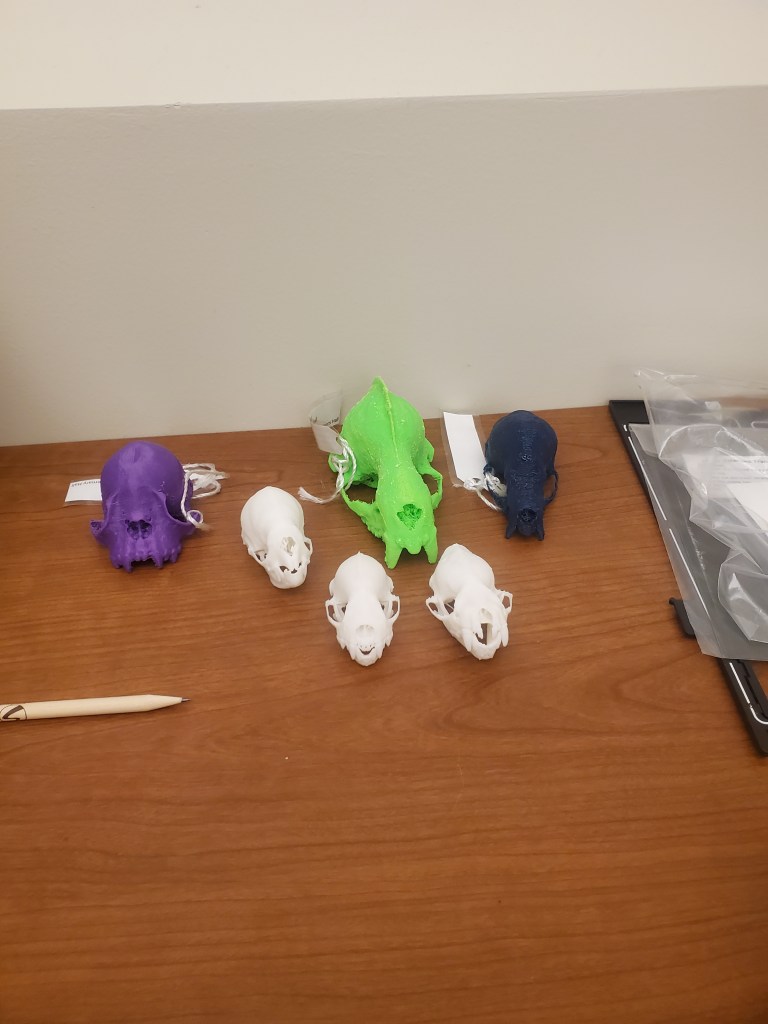
The final project will include lessons plan related to ecology of bats in Wyoming, crafting projects related to bat ecology, and hands-on education tools. Some of the proposed interactive tools include: 3D printed replicas of bat skulls to highlight morphological differences across different bat species (Fig. 2); felt bats to showcase diversity in bat size across the world; a paper bag bat puppet crafting activity to illustrate different physiological features and functions of bat morphology (Fig. 3); and a dichotomous key program to familiarize children with this common ecological research tool. Developing a conservation biology STEM initiative in bat ecology will hopefully improve local elementary-aged children’s understanding of biology and may improve the public’s perceptions of bats in Laramie.
My final lesson plan and informal bat education project will launch at the Albany County Public Library (ACPL) during their Test Tube Tuesday programming (3:45-5:45pm). The program will include stations dedicated to learning skills related to bat ecology. Children will learn how to use a dichotomous key to identify unknown species, will craft their own paper bag bat puppet, and will get to investigate 3D-printed models of bat skulls. Keep an eye out for this event by visiting the ACPL’s website and events calendar: https://www.acplwy.org/
The University of Wyoming’s Science Initiative eventually plans to distribute these bat-in-a-box programs to informal educators across the state! If you are an informal educator interested in receiving one of our STEM kits, please email Renee Lile (rlile1 [at] uwyo [dot] edu).
Renee Lile is a graduate student in the Bernard Lab in the University of Wyoming’s Department of Zoology and Physiology. Her graduate research focuses on maternity roost selection of Northern long-eared bats in Wind Cave National Park, South Dakota. Renee is originally from Lakewood, CO and earned her B.S. in Ecosystem Science and Sustainability (minor in History) at Colorado State University. She is passionate about intersectional feminism, environmental education, and conservation biology.
references
T. H. Kunz, E. Braun de Torrez, D. Bauer, T. Lobova, T. H. Fleming, Ecosystem services provided by bats. Ann. N. Y. Acad. Sci. 1223, 1–38 (2011).
P. Prokop, S. D. Tunnicliffe, “Disgusting” animals: Primary school children’s attitudes and myths of bats and spiders. Eurasia J. Math. Sci. Technol. Educ. 4, 87–97 (2008).
H. G. Shapiro, A. S. Willcox, E. V. Willcox, M. L. Verant, U.S. National Park visitor perceptions of bats and white-nose syndrome. Biol. Conserv. 261, 1–9 (2021).
D. F. Lawson, K. T. Stevenson, M. N. Peterson, S. J. Carrier, R. L. Strnad, E. Seekamp, Children can foster climate change concern among their parents. Nat. Clim. Chang. 9, 458–462 (2019).
Wyoming Public Schools, WYOMING PUBLIC SCHOOLS CURRICULUM GUIDE (2021).
 Engage Laramie Science