Post by Ellie Holloway
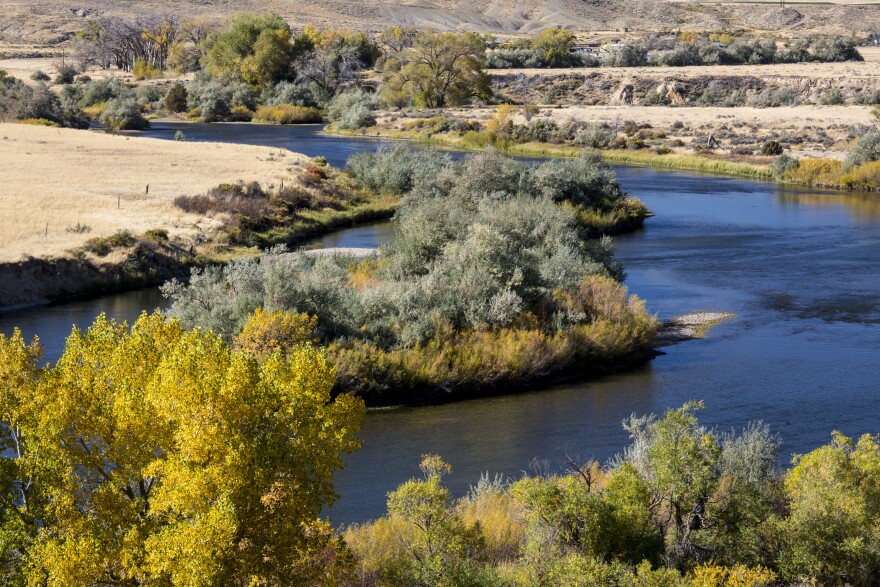
Casper, WY is home to many waterways used for various kinds of activities, one of which is fishing. These waterways are managed by the Wyoming Game and Fish Department who work to issue licenses for fishers and track how many fish are caught per season. Casper is also home to a fish hatchery which uses the numbers from the fishing season to calculate how many fish need to be bred and raised to replenish the waters for the next season. Many locals in the area enjoy fishing, but this fishing is not always done legally. Unfortunately, overfishing in the Casper area is a very common problem especially due to the many occurrences of fishing without a license. In 2020, there were 325 instances of fishing without a license in the Casper area (LaChance and Hirst 2021).
Overfishing can have severely detrimental effects on the ecosystem. Many of the effects that are understood regarding overfishing concern marine environments (WWF n.d.). However, many of these effects can also be observed in inland waters. Such effects include removal of top predators by fishers that alter food webs (Arlinghaus et al. 2019), differences in fish species due to crossing between hatchery and wild fish (Christie et al. 2016), and loss of species richness (Allan et al. 2005). Overfishing can alter an ecosystem in many different ways, which can be very harmful to a relatively smaller waterway such as the North Platte River (as compared to an ocean), and it can impact the management of local hatcheries as well.
This topic is important to me because I know people in the area who enjoy fishing the river and I know how important the waterway is to them. I also know that this waterway is a large part of Casper as it runs right through the town, so if the ecosystem is destroyed and the environment is devastated, it will likely have a large impact on the whole town. I also have important memories of visiting the fish hatchery and I know how important the fish hatchery is to the health and sustainability of the North Platte River ecosystem.
For my project, I decided to create a brochure that explains why it is important to be licensed when using the river for fishing activities and how being licensed can benefit the sustainability of the river ecosystem. I chose to use a brochure because it is a type of media that is accessible for many people and can be distributed broadly. I chose to create a brochure because it also forces me to be concise with my message while also allowing me to use images to
articulate my points. I did not want to make a project so big that people lose interest because they find it inaccessible, which is an important aspect to consider when engaging in scientific communication. I wanted to get a conversation happening among the anglers of the North Platte River about an issue they may have been unaware of and encourage them to share the message with others. An important concept to consider when sharing science is that people are not typically inclined to care about something unless it impacts them in some way. I believe that by explaining the benefits of getting a license and stating that overfishing could have an impact on those who use the river, people may be more willing to hear my message because it affects them personally.
In working on this project I had to take into consideration who would benefit from or be interested in this project and its outcomes, another important step when sharing science outside of the scientific community. I concluded that my project has the potential to be highly beneficial to fishery and hatchery managers that need accurate catch numbers every year in order to determine how many fish to rear, the fishery biologists and supervisors at the WGFD that also need accurate data for their studies and management decisions, conservationists that do not want to see the environment and its inhabitants destroyed, and, most importantly, the fishers who use the environment habitually and want to continue to use it without seeing it degrade.
Ultimately, I want this project to start a conversation about the problem of overfishing in the Casper area and get the local anglers involved to talk about it. I want people to better understand the answer to the question of “Why do I need to be licensed?” in reference to ecosystem sustainability. I also want the information I present to be accessible to anyone and it can be passed along to potential fishers of the river. This topic is important to me because the North Platte River is a big part Casper and I think it should be preserved for as long as possible, but this mission cannot only be taken on by the WGFD regulations, it should also be in the hands of the people who interact with the river regularly.
Ellie Holloway is a junior majoring in Zoology at the University of Wyoming.
references
Allan, J. D., R. Abell, Z. Hogan, C. Revenga, B. W. Taylor , R. L. Welcomme , and K. Winemiller. 2005. Overfishing of inland waters. BioScience 55:1041–1051.
Arlinghaus, R., J. K. Abbott, E. P. Fenichel, S. R. Carpenter, L. M. Hunt, J. Alós, T. Klefoth, S. J. Cooke, R. Hilborn, O. P. Jensen, M. J. Wilberg, J. R. Post, and M. J. Manfredo. 2019. Governing the recreational dimension of Global Fisheries. Proceedings of the National Academy of Sciences 116:5209–5213.
Christie, M. R., M. L. Marine, S. E. Fox, R. A. French, and M. S. Blouin. 2016. A single generation of domestication heritably alters the expression of hundreds of genes. Nature Communications 7.
LaChance, B., and G. Hirst. 2021, July 13. Wyoming issues 325 fishing without a license, 127 waste of Big Game Citations in 2020 – Casper, WY oil city news.
https://oilcity.news/wyoming/outdoors/2021/07/12/wyoming-issues-325-fishing-withouta-license-127-waste-of-big-game-citations-in-2020/.
What is overfishing? facts, effects and overfishing solutions. (n.d.). . World Wildlife Fund. https://www.worldwildlife.org/threats/overfishing.
 Engage Laramie Science