Post by Hunter Elliot
Almost every student has experienced this before in life, probably sitting a math class and a teacher is lecturing through material. Despite your effort to be focused and learn the material none of it seems to stick and it feels impossible to learn. Then fast forward to a different teacher that teaches it, suddenly, all the material just clicks and feels easy. Well, I have experienced this numerous times and through this semester in my CYOA’s. Through these CYOA’s I found an interest in the notion of teaching the same material in different styles. Before getting to far let’s define ‘teaching style’, teaching style is best described from an article as the following, “teaching style refers to a person’s pervasive instructional qualities that persist even though situational conditions may change” (Spoon, J. & Schell, J. 1998). This sparked the idea for this blog post, where we will look more in-depth at my CYOA and how the various back grounds impacted their teaching style, transitioning then into research-based portion of various teaching methods, and finally concluding with a person’s impact identity and their science communication.
The primary CYOA that sparked this interest was a CYOA in the wild, in which I attended a class that taught about electrocardiograms (EKGs). This course was taught by two instructors with radically different back grounds. One was an interventional cardiologist, who had several years of schooling and emphasis on the heart and EKGs. The next was a paramedic, who has had ample “street” experience, but only a couple years of education with a very broad focus of the human body. The two of them did a phenomenal job teaching, although in very different methods. Transitioning, to the differences that I noticed between the two. the primary thing I noticed is the jargon used between them. Well oftentimes each meaning the same thing I noticed that I would understand the cardiologist easier than the paramedic, I feel as though this was because of my personal background that related more closely to the cardiologist background of schooling. Although, there is a lot of EMS professionals attending this that appeared to understand the paramedic easier than the cardiologist. I find this very fascinating that depending on your backgrounds and the teachers background can impact on which you learn easier from.
Now, we were transitioning into more of the reason of why people learn better from others dependent on their background or teaching methods. To begin, it is notable that there are over qualities of teachers that universally are beneficial. These qualities are described by Vaughn, & Baker as flexibility, energy, and commitment (Vaughn, & Baker, 2001). Moving forward, when effectively trying to teach and engage an audience one of the most common methods used is telling stories that learners can relate to. Here students that have similar backgrounds to that of their teachers will often resonate with the stories that teachers use better. This often leads to a greater understanding and it deeper level of learning from the student. Furthermore, as discussed jargon plays a huge role into being able to effectively understand a teacher, in students of teachers of similar backgrounds generally share similar vocabulary.
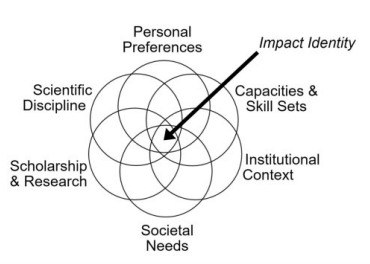
Moving forward, another reason that we will investigate is one’s impact identity. An impact identity is who a person is and who the affects their sharing of science. Impact identity is made up of several different components, which these components and how they intertwined can be seen in figure 1. It is important to note that just as a person’s teaching style can change, a person’s impact identities are malleable and shift. Overall, this gives some brief reasoning as to the reason and importance of backgrounds and being able to effectively teach some students better than others.
So next time you’re sitting in class or a lecture and struggling to retain any information, perhaps you can think back to this post. There is several aspects that impact how one teacher. One aspect is your background, weather you are a cardiologist or paramedic, you can communicate the same information in vastly different ways. On top of this, a person’s impact identity also plays a huge role in one’s teaching. Overall, there are several aspects that affect how one teaches and it also greatly affects how well the student understands and retains this information.
Hunter Elliott is an undergraduate student in the Department of Zoology and Physiology at the University of Wyoming.
references
Risien, J., & Storksdieck, M. (2018). Unveiling impact identities: A path for connecting science and society. Integrative and Comparative Biology, 58(1), 58-66.
Vaughn, L., & Baker, R. (2001). Teaching in the medical setting: balancing teaching styles, learning styles and teaching methods. Medical teacher, 23(6), 610-612.
Spoon, J. C., & Schell, J. W. (1998). Aligning student learning styles with instructor teaching styles. Ethnicity, 45(44), 23-40.
 Engage Laramie Science