Post by Logan Detweiler
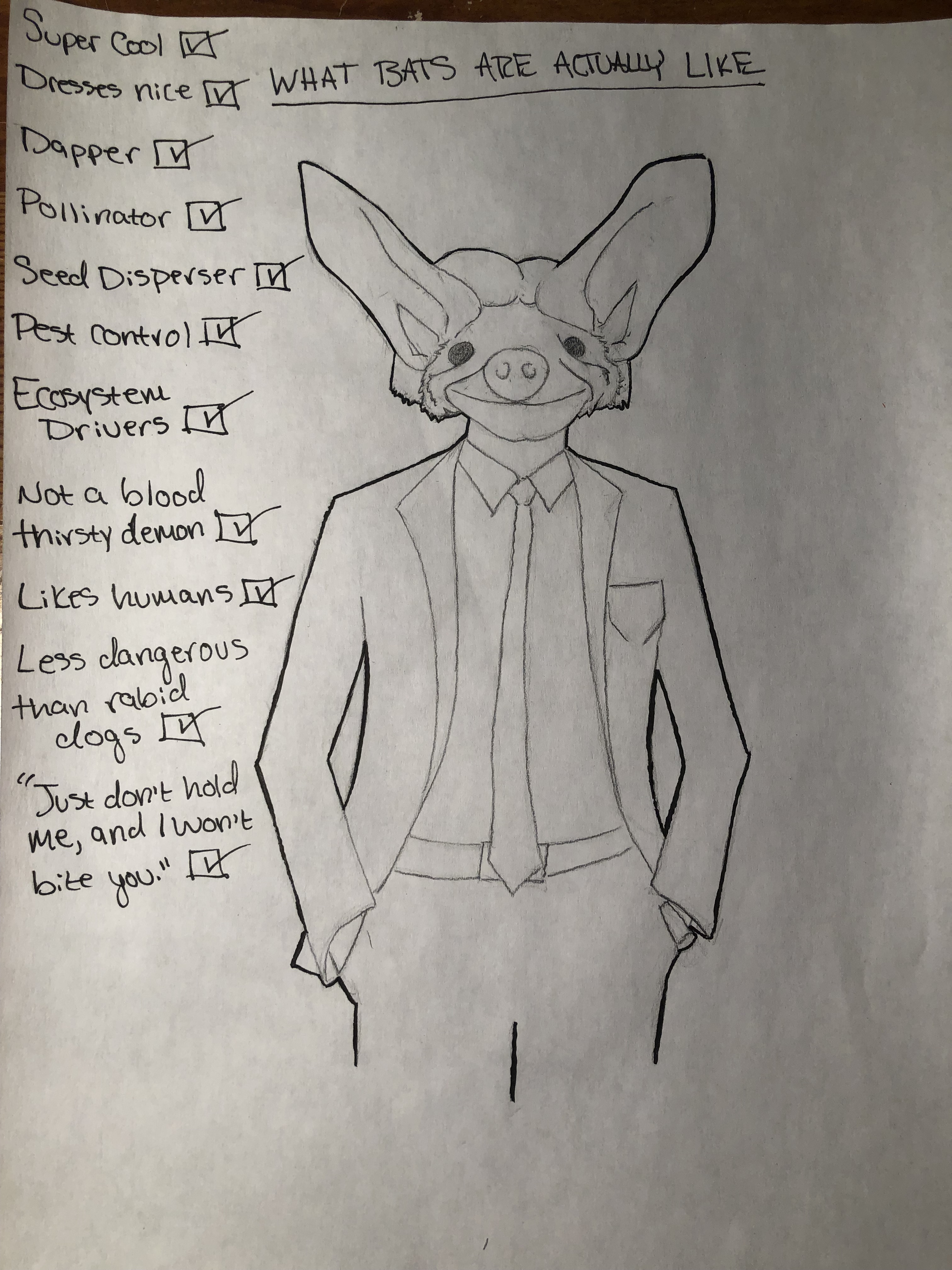
Prior to being accepted into graduate school at the University of Wyoming, I knew very little about bats. At the time, the only knowledge I had about bats was acquired from a mammalogy course I took as an undergraduate student. Once I was accepted into graduate school, I told friends and family that I would be working with bats and their reactions were less than pleasant. “They’re riddled with diseases and rabies!” they’d say. What was funny about this, is that I know for a fact my family and friends know nothing about bats, and everything they think they know has been acquired from myths and misconceptions. Unfortunately, most of western society feels the same way towards bats as my friends as family. As a result, I felt obligated to stick up for the little fellers. Before diving into my blog, I would first like to explain my communication style. I love to draw, and above all, I don’t like to take things too seriously. What does Bugs Bunny say? Don’t take life too seriously, you’ll never get out of it alive. That said, I wanted to include basic facts and common misconceptions about bats and use illustrations and satire to spice up the blog. Enjoy.
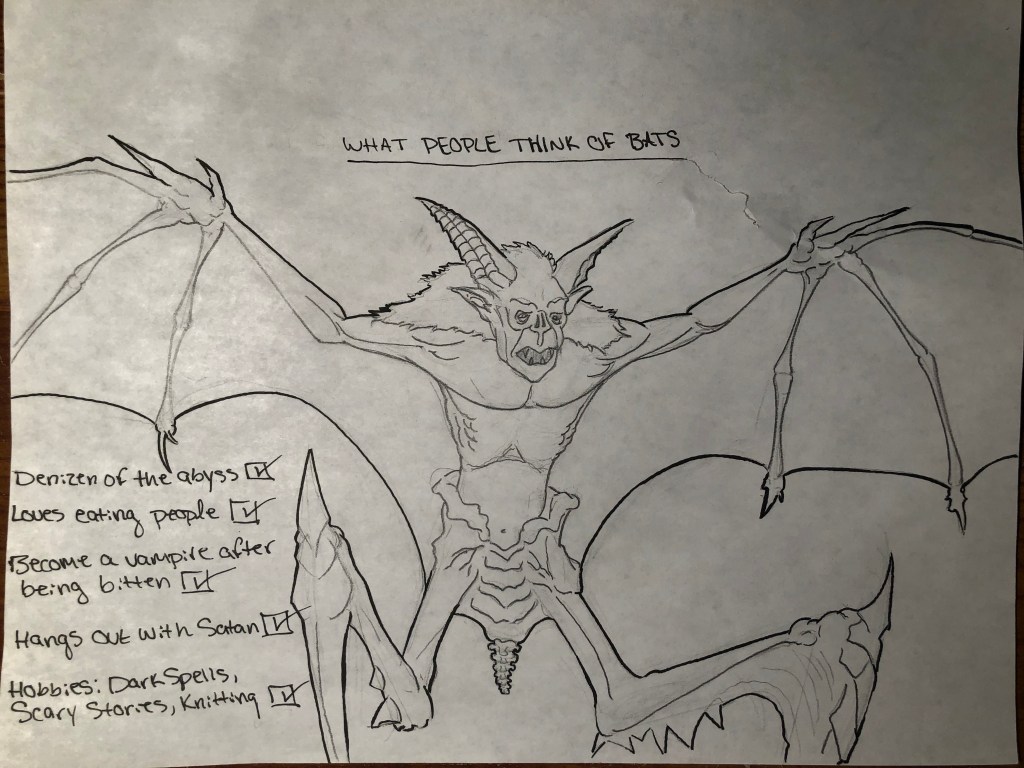
Despite the critical importance of bats to the ecosystem and economy, the public’s perception of bats has been historically negative as bats are often portrayed as harbingers of disease, rabies, and demonic juju. The misconstrued reputation of bats can be traced back to ancient times. Bats were not encountered as much as other animals due to their nocturnal life-characteristics and small size; thus, they became known as mysterious, magical creatures often associated with death and evil. The bad reputation of bats has even found its place in the bible and can be seen in the last days: “In that day a man shall cast his idols of silver, and his idols of gold, which they make each one for himself to worship, to the moles and to the bats (Isaiah 2:20)”. It has also been considered that at the time of the Authorized Version of the Bible (1611), bats were often thought to have been associated with witches and warlocks, and to possess demonic powers as they reside in their dark, damp caves with the devil. One of the most famous drivers of bad bat reputation was the 1897 novel Dracula by the Irish author Bram Stoker. The book’s view is nothing short of depicting bats as dark, evil, bloodsucking monsters.
In actuality, only 3 of nearly 1,400 species of bats are bloodsuckers. Moreover, these 3 species of bloodsuckers primarily feed on wildlife and domestic livestock. The other approximated 1,397 species eat fruit, invertebrates, fish, reptiles, amphibians, birds, and sometimes other bats. Additionally, a 1999 horror film titled Bats involves the grisly deaths of humans by bats in a small town in Texas; thus, adding another layer of misconception. Bats also have a bad reptation because of rabies. Now, there is some truth to this. Some bats do indeed carry rabies and there have been bat-mediated human deaths from rabies; however, animals from the order carnivora such as dogs, foxes, raccoons, and skunks pose far greater threats to humans than bats. Rabid dogs, for example, are known to attack pedestrians on the streets whereas rabid bat bites occur from ignorant handling. Rabid bats do not attack people. That said, leave bat handling to trained and protected professionals.
Bats have been flying around the world for nearly 60 million years on all continents except Antarctica and are essential to the various types of ecosystems they inhabit, from rainforests to deserts. Bats are responsible for many ecological roles and by doing so, bats promote biodiversity and support the health of their ecosystems. For example, bats are critical for the pollination of valuable commercial crops such as bananas, mangos, guavas, agave, cashews, cloves, and figs. Without bat pollination and seed-dispersal, many ecosystems would eventually die-off as plants would fail to produce food and shelter for other wildlife. Insectivorous bat species can eat up to 30-100% of their body weight of insects and other arthropods each night. Most of the insects consumed are pesky, crop-destroying insects which reduces the need for agricultural pesticides. For example, a single colony of 150 big brown bats in Indiana is estimated to consume nearly 1.3 million pest insects a year. Fortunately, big brown bats are found throughout North America, Canada, and Central America where some colonies can be in the thousands. Furthermore, a single little brown bat can consume up to 600 mosquitoes in just an hour. In the United States alone, the estimated value of bats to the agricultural industry is roughly $22 billion per year with highs reaching $53 billion per year. These critters definitely give a helping wing to taxpayers! Science has also been studying the importance of bats to human health.
Current research is studying vampire bat saliva and its potential applications for human heart disease. Vampire bat saliva contains an anticoagulant which prevents blood from clotting. Additionally, bats eat copious amounts of mosquitoes which can help control the spread of West Nile Virus and other vector-borne infectious diseases.
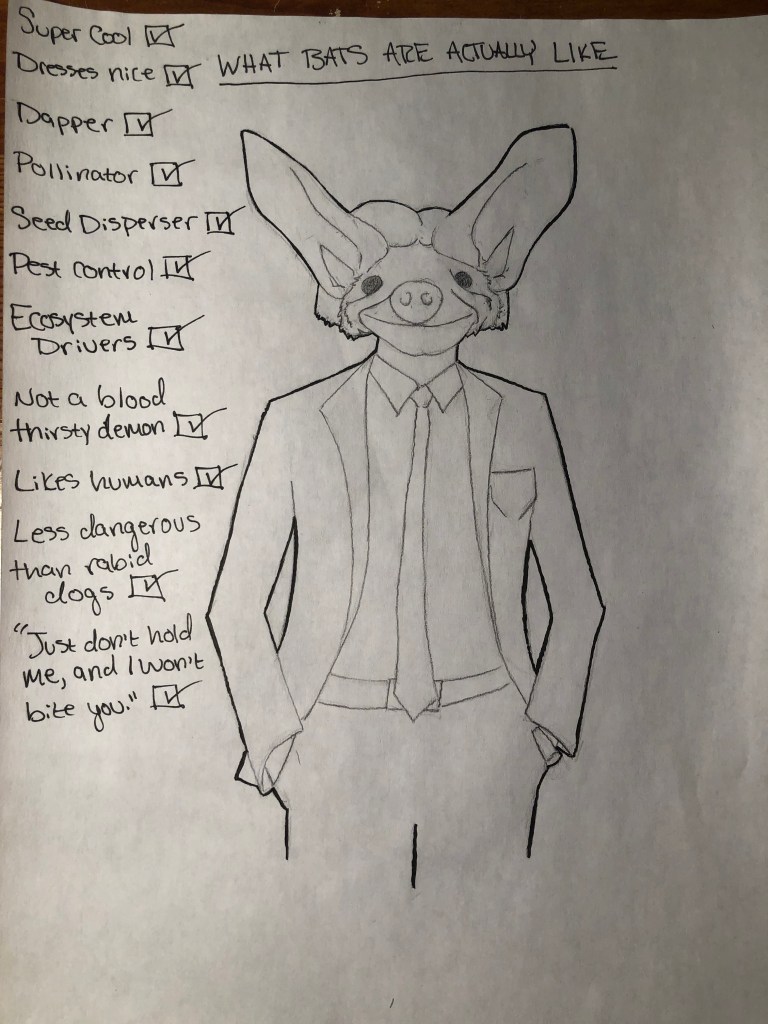
It is safe to say I am now more bat savvy than I was a year and a half ago. Having the privilege to study these amazing animals, I have been able to clarify some myths and misconceptions about bats. A few family members were unenthused about my project at first but are now interested and hungry to know more about bats. Everything that I have addressed about bats in this blog is not even scratching the surface of how important bats are to the natural world. Though I have only informed my friends and family and a select few individuals regarding the truth about bats, this goes without saying that scientific communication is critical for reaching larger audiences in an evolving world. As scientists, we can use our skills to communicate facts, speak the truth, and set the record straight – especially when it comes to bats.
Logan Detweiler is a Master’s in the Zoology and Physiology Department at the University of Wyoming
references
Boyles, JG, PM Cryan, GF McCracken, and TH Kunz. 2011. Economic importance of bats in agriculture. Science 332:41-42.
Hoffmaster, E, J Vonk, and R Mies. 2016. Education to action: Improving public perception of bats. Animals 6.
Lunney, D, and C Moon. 2011. Blind to bats. The Biology and Conservation of Australasian Bats 44-63.
 Engage Laramie Science