Post by Mercedes Cassidy
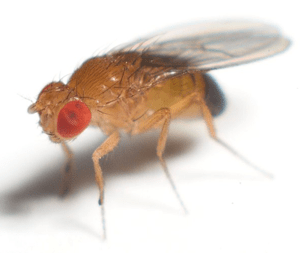
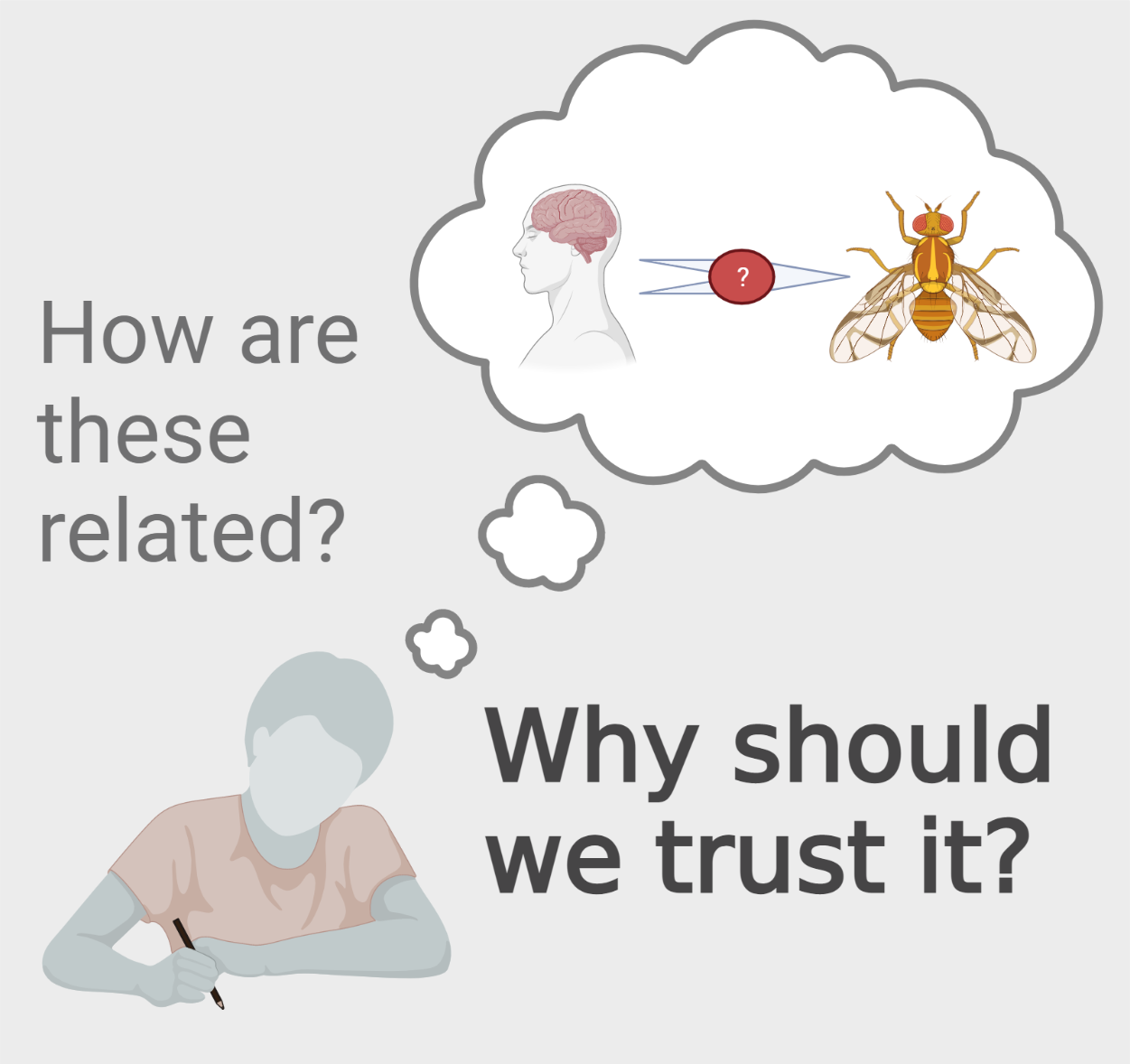
This last Christmas, while enjoying the spirit of the season and the company of family not often seen, conversations about current jobs arose. Inevitably, aunts and uncles ask: “How has your work in the lab been? What have you been working on?” These are easy enough questions but when I reply, “I’ve been studying a genetic disease-causing decreased head size in humans, but we study why and how this develops using fruit flies,” I inevitably get the ultimate question “Whoa… wait… hold up, why would you use fruit flies?”
Excellent question. Why would the lab I work in use fruit flies to understand development through a genetic disorder in humans? Fruit flies are a model organism (animal) among a larger group of model organisms – like certain species of bacteria and even mice – that are used to answer questions we cannot necessarily answer by trying to study humans. This matters because it is the basis for much of modern biomedical science investigation.
The real question here is why does it take innocent questions at a family party to learn this information? Interestingly, this is the intersection of scientific communication and communicating what science looks like – people should know about how biomedical science is done. They should see that there are tools that help us to answer questions but do not provide all the answers. Maybe that’s the problem now – people do not know this and so science seems foreign and untrustworthy despite the scientists’ training (Fiske and Dupree). That is an actual problem potentially solvable by talking about scientists’ investment in science.
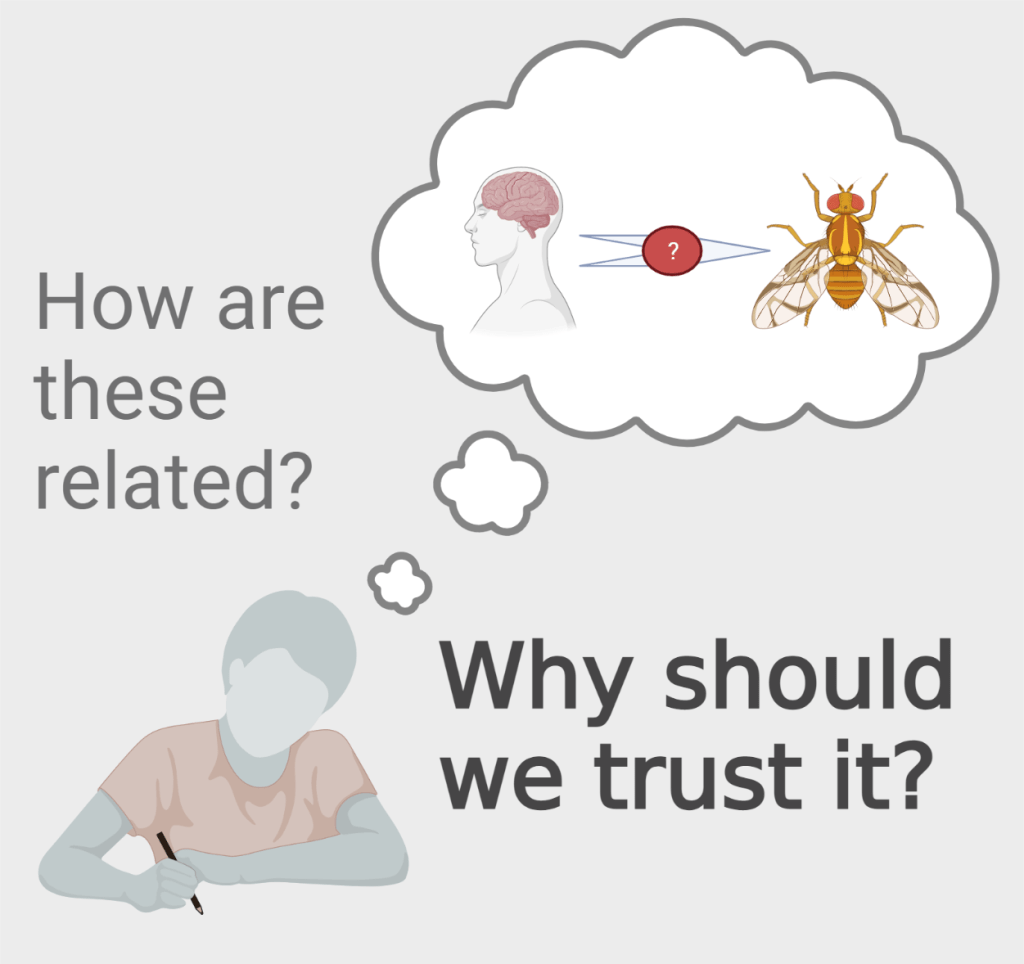
Understanding how people trust one another and the authority figures around them is a critical part of bridging this gap between audiences and scientists. In a paper title “Gaining Trust as Well as Respect in Communicating to Motivated Audiences about Science Topics”, the authors Fiske and Dupree provide enlightening data showing that when audiences were asked to rate different careers on competence versus “warmth” (trustworthiness), scientists scored high in competency, but were viewed as “cold” (Fiske and Dupree, 13595). Fiske and Dupree argue that this could be due to a lack of surety that scientists are communicating their care for humanity and the inherent uncertainty within scientific research (Fiske and Dupree, 13596). Opinions and persuasion are not critical – instead it is the seeming objectivity of science and discussion with audiences that matter most to building trust.
Logically, it follows that we must address the issue; we need to communicate science without a veneer of persuasion or perfection but with the intent of helping audiences to see it for the learning process it is – the chance to explore unknown knowledge and to help solve problems affecting the world. In the cases of biomedical research – topics like genetics, ecology, immunology, and infectious disease study rely on tools that people do not often understand to be relevant to studying processes let alone human ones. When introducing tools like model organisms into the discussion, it is important to talk about what the term “model” even means in the context of research. Even more importantly, part of being transparent and helping audiences feel more connected and trust of scientists includes clarifying that these models are intended to describe a conserved process in general terms that could apply to a broad spectrum of organisms (Ankeny and Leonelli, 318).
The power of generalizing findings to other organisms is what makes model organisms a valuable tool. However, we must always be willing to explain to audiences that just because they are models, does not mean that the specifics of these processes are retained across organisms; therefore, these things must be investigated in the organism of interest like humans or mice (Barré-Sinoussi and Montagutelli, 2). Ultimately, how do trust, ideas of competence, and model organisms intersect? Model organisms are one of the things that can be shown to audiences and communicated about to help build understanding of how our knowledge is achieved – not just that it is achieved.
In the context of my own experiences, it often feels like people see bits and pieces of science but lack the context to understand motive or intent – like why fruit flies can be models for processes in humans. While not every scientist conducts research to benefit people with a certain disease or to find a potential solution for environmental issues, showing science as a process that relies on tools that we have available – assumptions based on decades of prior knowledge – could help drive home the idea that scientists are just people attempting to learnwith the tools available. It may even offer the perspective that the process is always being evaluated for improvement; data is perpetually reviewed to ensure the answers are as close to the currently understood truth as possible.
Uncertainty cannot be eliminated but there is no reason that this same uncertainty cannot be the mechanism for bridging the gap between scientists and their audiences – everyone is human and at the end of the day, organisms like fruit flies are an incredibly useful tool that we use as best we can to learn as much as possible when other avenues are unavailable – or overly complicated.
Mercedes Cassidy is an undergraduate majoring in Physiology at the University of Wyoming and does research in a molecular biology laboratory on the campus.
references
Ankeny, Rachel A., and Sabina Leonelli. “What’s so Special about Model Organisms?” Studies in History and Philosophy of Science Part A, vol. 42, no. 2, 2011, pp. 313–323. https://doi.org/10.1016/j.shpsa.2010.11.039.
Barré-Sinoussi, Françoise, and Xavier Montagutelli. “Animal Models Are Essential to Biological Research: Issues and Perspectives.” Future Science OA, vol. 1, no. 4, 2015. https://doi.org/10.4155/fso.15.63.
Fiske, Susan T., and Cydney Dupree. “Gaining Trust as Well as Respect in Communicating to Motivated Audiences about Science Topics.” Proceedings of the National Academy of Sciences, vol. 111, no. 4, 2014, pp. 13593–13597. https://doi.org/10.1073/pfnas.1317505111.
 Engage Laramie Science