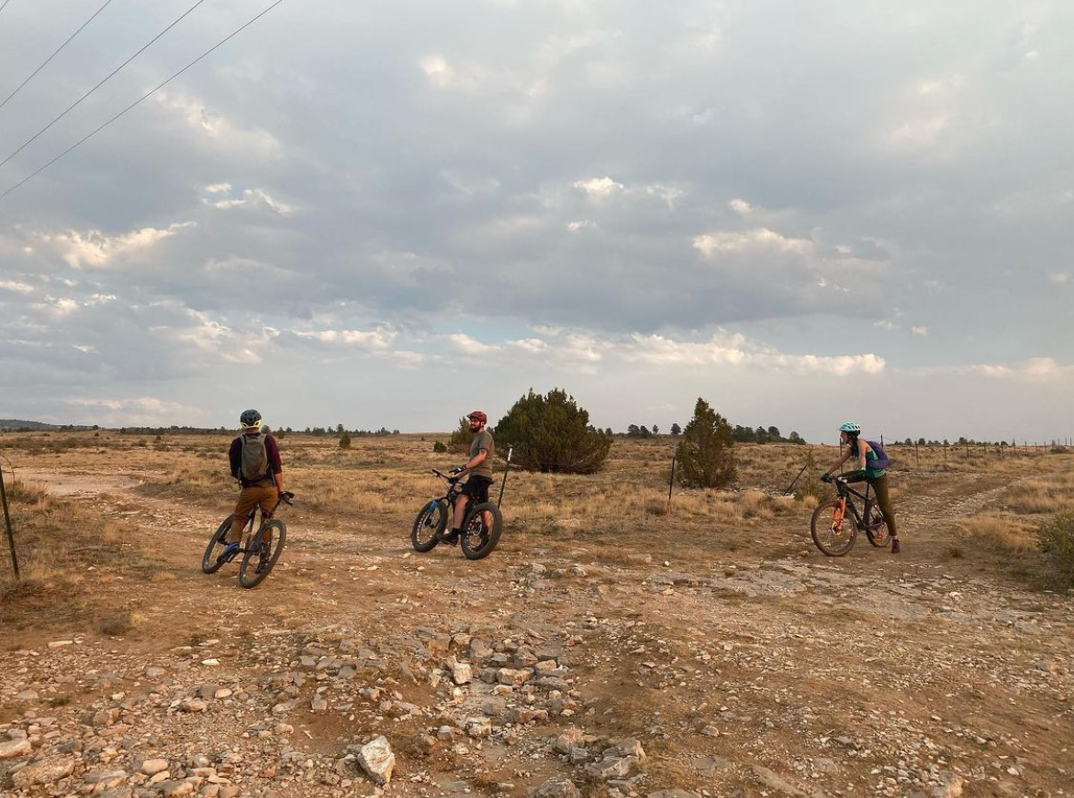
Post by Kaitlyn McKnight

Back in 2017, during a wilderness literature course at Ohio University, I participated in a heated debate about allowing mountain biking in designated wilderness spaces. At this time, I didn’t even really know what a designated ‘wilderness area’ was nor had I ever been on a mountain bike, so I didn’t add a strong argument. One thing that stuck with me however that I learned while researching in preparation for the debate was that there was very little research on the impacts of mountain biking on natural spaces overall. I thought this was kind of odd considering a new trail system was just proposed in our area that would expand the mountain biking community’s access to trails considerably. Forgetting about the debate shortly after (it was the last semester of my senior year, things were going in one ear and out the other at this point… can you blame me?), I hadn’t really thought about these ideas until recently.
Fast forward 2 years, in the summer of 2019, I found myself both mountain biking for the first time and backpacking into the largest designated wilderness area in the lower 48, the Frank Church River of No Return Wilderness. With the added personal experience, the debate briefly popped into my head and I thought to myself I still stand with the ‘against’ side, but then quickly left again and I really hadn’t thought much about it until I moved to Laramie, 2 years after that.
That brings us to today, and you’re probably wondering why you should care about this story. Well, that’s because it’s been 5 years since I looked into the details of this debate and I was SHOCKED to find out that there is still very little research on the impacts of recreating on our wild spaces, especially mountain biking. And living in Laramie I thought to myself, there is a huge trail system right outside my door, how is this possible? Which is why I propose that the Pilot Hill project could be the perfect partner to lead this important work and bring attention to the importance of researching the impacts of using our landscapes for recreation.
Some research does highlight that the impacts of mountain biking are similar to those of hiking and horseback riding. The primary impacts include soil compaction and loss, overall reduced soil moisture, and the loss of organic matter, ground cover objects, and native plant species. The introduction of invasive species can be exaggerated by increased traffic and movement as well. Specific to mountain biking, impacts tend to occur rapidly at the opening of trails and then taper off slowly through the season. Though less loose sediments are produced overall compared to hiking, erosion from skidding, linear rutting, and the creation of informal trails are much more prevalent, directly altering the terrain (Pickering et al. 2010).
These results are consistent with what local recreators are seeing at Pilothill. I sent a survey to both mountain bikers and ecologists to gauge their thoughts on the impacts and how they think we could begin to manage for them and whether or not they think it is important to prioritize this type of research. The majority of folks responded that they are seeing increased erosion, trampled vegetation, the creation of ‘social trails’, and a lot of dog poop. I also recieved quite a few responses in regards to the displacement of wildlife in the area, which is a separate but important impact. According to a study done on Red Deer, the animals avoided areas up to a 40m radius of any trail (Scholten et al 2018).
The overwhelming answer for how to start managing for these impacts were rooted in a prevention approach by increasing educational materials about trail etiquette and the ecology of the system to spark a connection to the landscape. So, there is my answer I think. Education is the route science communication can take to bridge the research gap between recreators and the impacts recreation causes to natural spaces. By increasing the awareness of the impacts and how to prevent them, this could draw attention to the necessity to study these impacts more thoroughly and make adjustments along the way. Then I think once we have a clear grasp on the results, we can revisit the debate of mountain biking in designated wilderness areas and whether or not we want to disturb our highest degree of preservation.
Kaitlyn McKnight is a 2nd year PhD. student studying theoretical community ecology and is interested in concepts of biodiversity, synchrony and stability of ecosystems.
references
Pickering, C. M., Hill, W., Newsome, D., & Leung, Y. F. (2010). Comparing hiking, mountain biking and horse riding impacts on vegetation and soils in Australia and the United States of America. Journal of environmental management, 91(3), 551-562.
Scholten, J., Moe, S. R., & Hegland, S. J. (2018). Red deer (Cervus elaphus) avoid mountain biking trails. European journal of wildlife research, 64(1), 1-9.
 Engage Laramie Science