I love talking to people about astronomy, but boy oh boy it can be difficult sometimes.
Astronomy is the most hands-off science out there, because everything under study is literally out of this world.
When people ask about my research I either say, “I study quasars” (something most people have never heard of) or “I study supermassive black holes” (which is something that cannot be seen).
I figured I needed an epic graphic that both illustrated and briefly explained these objects so that I could spread the awesomeness of quasars with the world.
You may have seen gorgeous pictures of nebulae and galaxies taken by the Hubble Space Telescope. Unfortunately, I can’t give you a spectacular photograph of a quasar because they are very small and very far away.
There are basic diagrams depicting what quasars look like, and there are extraordinary artist depictions, but to me there didn’t seem to be a nice graphic that was both informative and appealing to the eye.
|
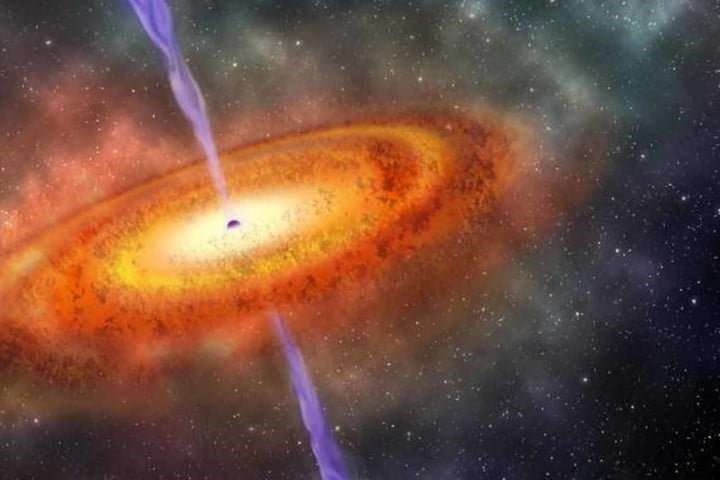
An artistic rendering of a quasar. Image Credit: Robin Dienel / Carnegie Institution for Science.
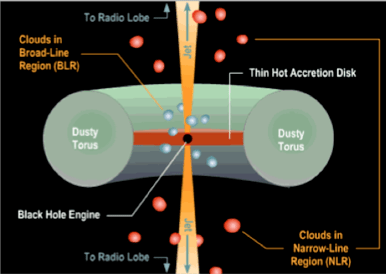
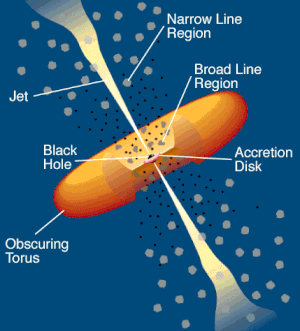
Unified model of an AGN. Different types of energy are emitted from each part of the AGN, meaning that our observations greatly depend on orientation. Image Credit: Brooks/Cole Thomson Learning
|
A digarm of the unified model of an active galactic nucleus (AGN). Image Credit: C.M. Urry and P. Padovani
|
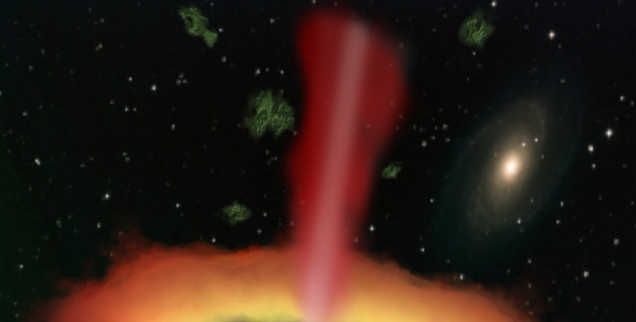
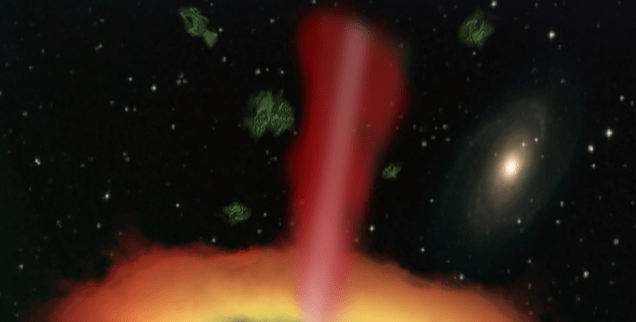
I decided to change that so that the public could become as excited about quasars as I am. My image, regrettably, doesn’t depict the proper size-scale of a quasar because the difference between the smallest and biggest parts is too extreme to allow all parts to be visible at once. Aside from that minor detail, I believe I accurately depicted the shapes, colors, and textures of each region to provide a (mostly) accurate representation. That along with the brief statements to the side that provide some context makes this graphic a success in my book.
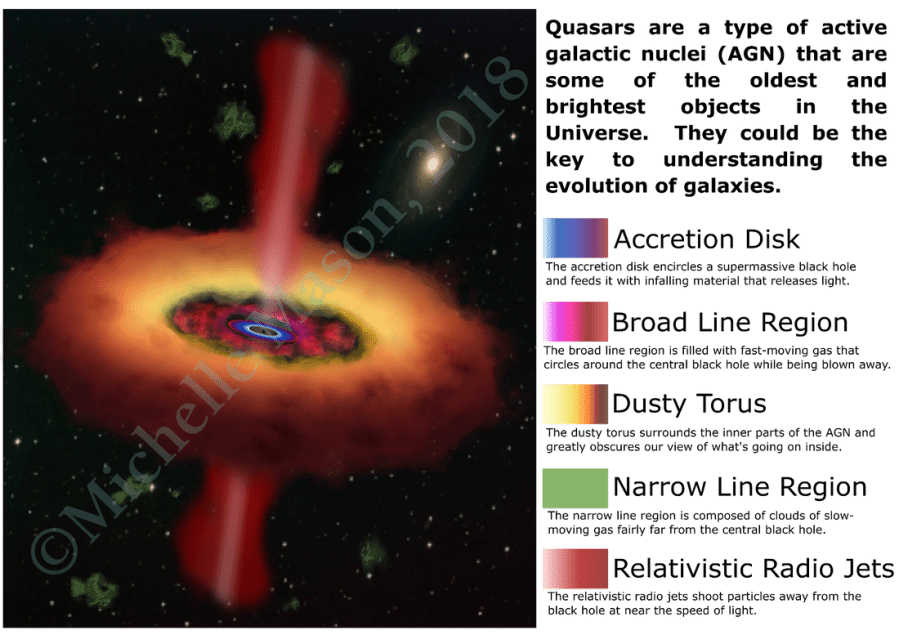
Quasars are a type of active galactic nuclei (AGN) that are some of the oldest and brightest objects in the Universe. They could be the key to understanding the evolution of galaxies.
- Rectangle with color band that is blue to purple to dark red: Accretion Disk – the accretion disk encircles a supermassive black hole and feeds it with infalling material that releases light.
- Rectangle with color band that is bright purple to pink to dark red: Broad Line Region – the broad line region is filled with fast-moving gas that circles around the central black hole while being blown away.
- Rectangle with color band that is light yellow to orange to brown: Dusty Torus – the dusty torus surrounds the inner parts of the AGN and greatly obscures our view of what’s going on inside.
- Rectangle with color band that is medium green: Narrow Line Region – the narrow line region is composed of clouds of slow-moving gas fairly far from the central black hole.
- Rectangle with color band that is a gradient from light to dark red: Relativistic Radio Jets – the relativistic radio jets shoot particles away from the black hole at nearly the speed of light.
 Engage Laramie Science