Visualizing Science: Making a complex research project more approachable

Post by Jessica Berg

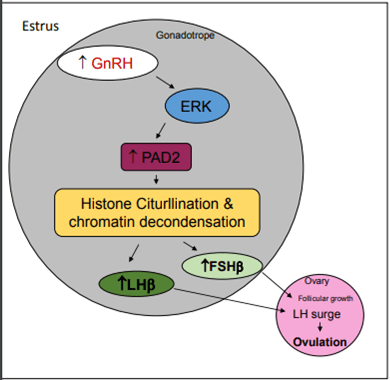
Diagram of estrus-related hormones and physiology. White box contains a large gray circle and a small pink circle. Upper left corner contains the word estrus. Lower right corner includes pink circle which contains, top to bottom, the text ovary, folicular growth, LH surge, arrow pointing down, ovulation. Large gray circle contains, from top, the word gonadotrope, an ellipse with an upwards arrow and GnRH in red. Arrow down-right to blue ellipse with ERK. Arrow down-center to red rectangle that has up-arrow and PAD2. Down arrow to large yellow rectangle with text: Histone Cirturllination & chromatin decondensation. Down-left arrow to green ellipse that contains up-arrow LHB, which has a right arrow leading over to the pink circle. The yellow rectangle is also connected to a light green oval via a down-right arrow. The light green ellipse contains an up-arrow and FSHB. This ellipse also has an arrow connecting it to a pink circle.

Summary slide of overarching effects of my research. Credit: © Jessica Berg, 2018

I signed up to take Visualizing Science, initially, so that I could improve my animation skills as well as develop my slide design more for my thesis defense.

However, shortly after beginning the class, I realized that my science isn’t easy to comprehend for those who are not reproductive endocrinologists. This realization made me shift goals a bit. Instead of making my complex data look good I now wanted to make my complex data look simple (and good).

My target audience changed from my lab mates and principle investigator to my friends in graphic design and education, as well as my parents.

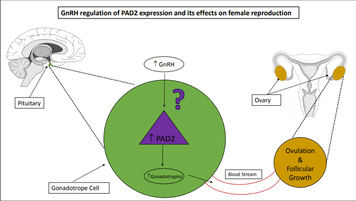
Diagram of a brain, with the pituitary gland highlighted. It is zoomed in to a large green circle labeled with

Moving toward a more approachable visual of my research. Credit: © Jessica Berg, 2018

Picture

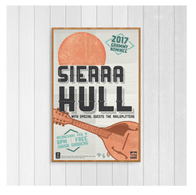
This poster was created by my friend. I really like the layered effect of this poster Credit: © Darby Clark

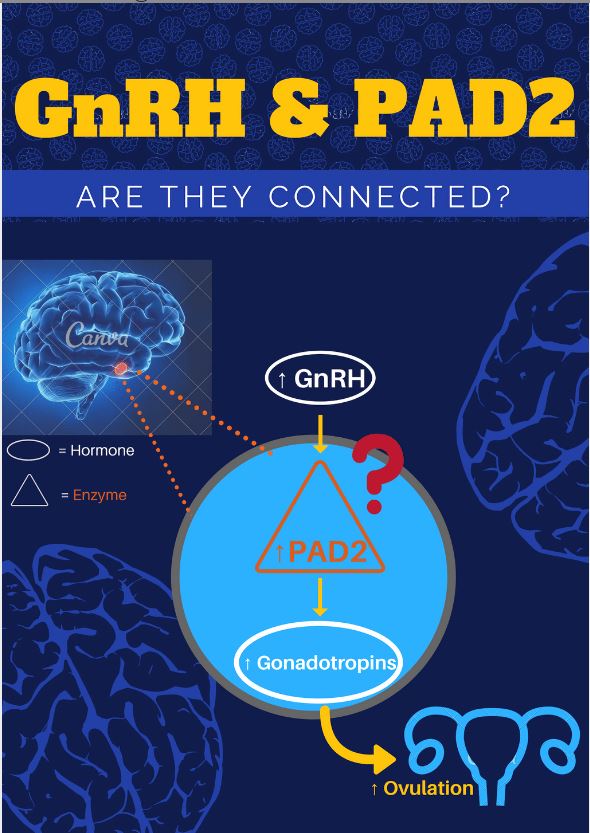
​With this change in audience came a change in design and delivery. I removed many of the jargony words and added simplified structures. Instead of saying “gonadotropes within the pituitary” I just added a picture of where the pituitary is and zoomed in on the cells within that gland. This is what I came up with:
Title: GnRH & PAD2: Are They Connected? Diagram of a brain, with the pituitary gland highlighted. It is zoomed in to a large blue circle labeled with. The large blue circle contains a large red question mark, a red-outlined triangle containing an up-arrow and PAD2, and an ellipse labeled gonadotropins. An arrow leads down to the top of the large circle, from an ellipse with an up-arrow and GnRH. The gonatotropin ellipse (bottom of large blue circle) has an arrow pointing to a simplified illustration of the uterus and ovaries. The image is labeled ovulation. The background is dark blue, with lighter blue brain illustrations scattered throughout.

Visualization of hormone research, created using Canva. Credit: © Jessica Berg, 2018

I also tried to use identifiable structures within the body like the brain and the basic structure of the female reproductive tract so that people wouldn’t get lost before they even began looking at my design.

Additionally, I added a backdrop of the brain to emphasize that the brain is the location of much of my research.

With the design I also tried to limit my use of color so that when there was a drastic change in color it emphasized a point. An example of this is when I added a question mark in red to highlight the focus of my research.

​As I keep working on this I’d like to simplify the brain diagram so that it is more similar to the female reproductive tract. I also think a more compelling/less sciency title might play to my advantage in attracting people with non-science interests to my research.
 
Overall, I really enjoyed the progression of this project and found that the process really helped me to solidify, in my own mind, the most important points of my research. 

Leave a comment