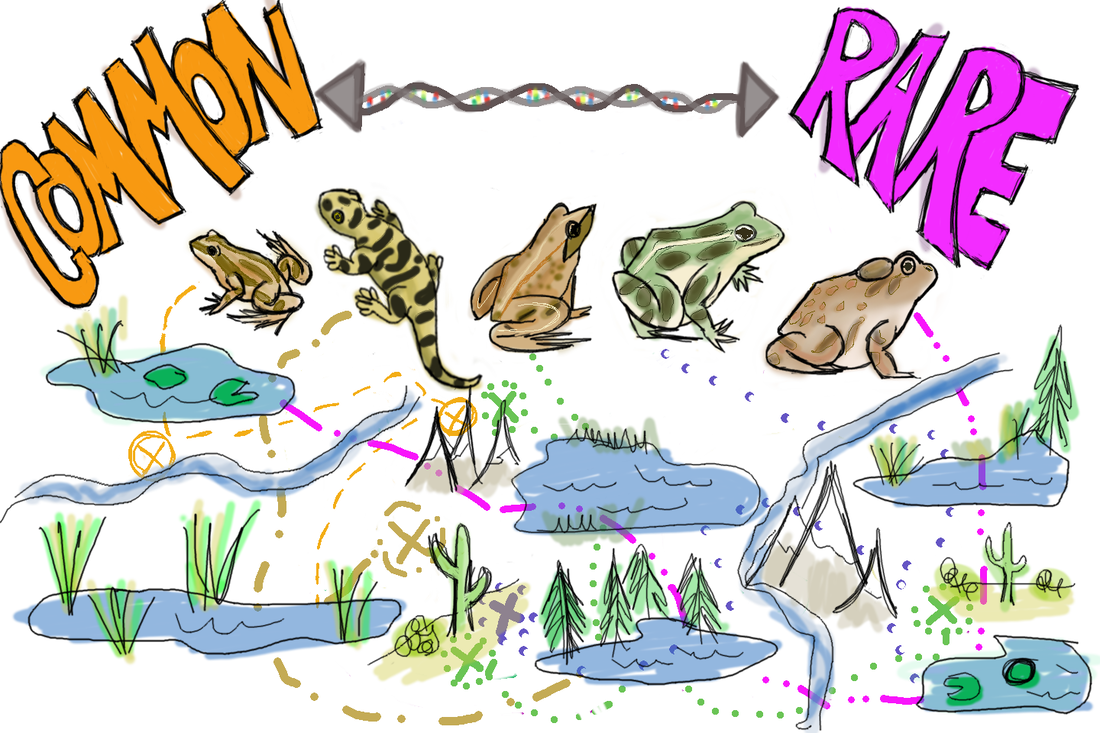
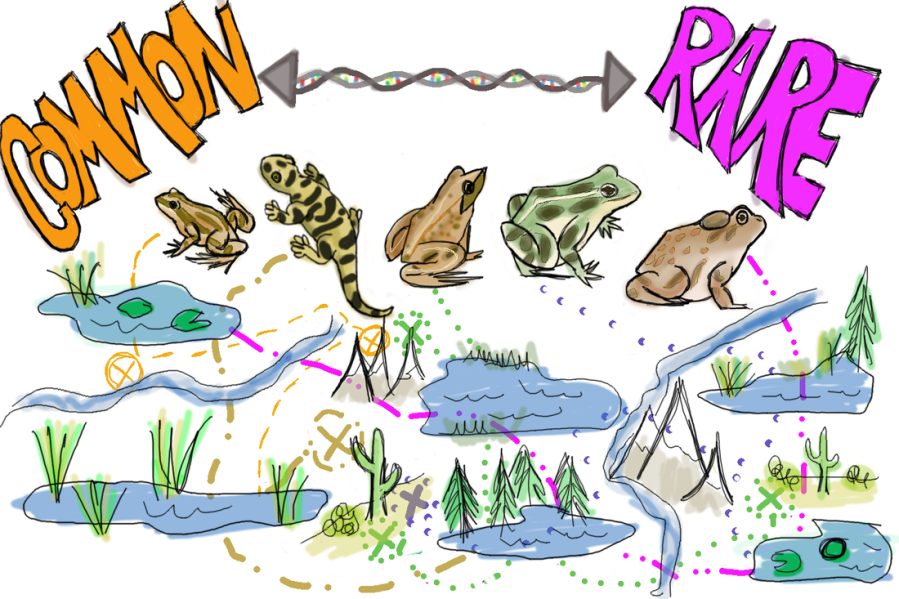
What a busy drawing! This is a first attempt at visualizing PhD research on niche breadth and functional connectivity in amphibians. Image by M. L. Torres. ©2018
Hello artists and scientists alike!
Mel Torres here – you may recognize me as the PhD student studying amphibians as part of the Art of Science Communication course blog last year. I’m glad to be back, and I’m blogging on a whole new subject (…well, sort of! #AlwaysAmphibians). I’m currently taking Visualizing Science at UWyo, and I cannot express how excited I am to learn about incorporating artwork into my science. As an amateur artist in my younger days, I’m enthusiastic for the opportunity to show off the two things that I enjoy; drawing and disseminating scientific research to you!
Mel Torres here – you may recognize me as the PhD student studying amphibians as part of the Art of Science Communication course blog last year. I’m glad to be back, and I’m blogging on a whole new subject (…well, sort of! #AlwaysAmphibians). I’m currently taking Visualizing Science at UWyo, and I cannot express how excited I am to learn about incorporating artwork into my science. As an amateur artist in my younger days, I’m enthusiastic for the opportunity to show off the two things that I enjoy; drawing and disseminating scientific research to you!
|
The artwork that I am posting about and analyzing today is my first drawing assignment for the Visualizing Science course. We were asked to draw our science, and while that sounds simple enough, I found it to be extremely challenging. There are so many components in my research that I couldn’t pick just one, leading to the very busy and convoluted art piece you see above.
|
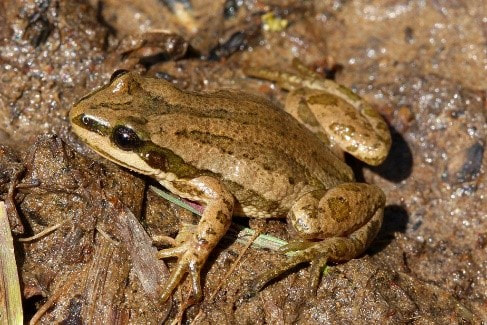
Boreal chorus frog (Pseudacris maculata used as drawing reference. Image by J. N. Stuart via Flickr.com. Labeled for noncommercial reuse.
|
See, my research at the University of Wyoming is about determining how differences in rarity, i.e. species that range from common to infrequent within an area, influence the range in resources that a species uses (niche breadth). Additionally, my research is looking at dispersal, specifically what landscape variables either promote or inhibit movement between habitat patches (functional connectivity). To answer my questions, I collect DNA from individuals and the environment (eDNA).
Thus, my dilemma in drawing my science is due to the complicated nature of my research. For the design of this artwork, I aimed to draw all five of my focal study species, showing the gradient from common (boreal chorus frog) to rare (boreal toad) amphibians on the Wyoming landscape. I also wanted this piece to be more comic-style versus my usual realism; my target audience for this piece was young adults (high school – college), and I thought something with fun letters and bright colors would be perfect for this objective.
Thus, my dilemma in drawing my science is due to the complicated nature of my research. For the design of this artwork, I aimed to draw all five of my focal study species, showing the gradient from common (boreal chorus frog) to rare (boreal toad) amphibians on the Wyoming landscape. I also wanted this piece to be more comic-style versus my usual realism; my target audience for this piece was young adults (high school – college), and I thought something with fun letters and bright colors would be perfect for this objective.
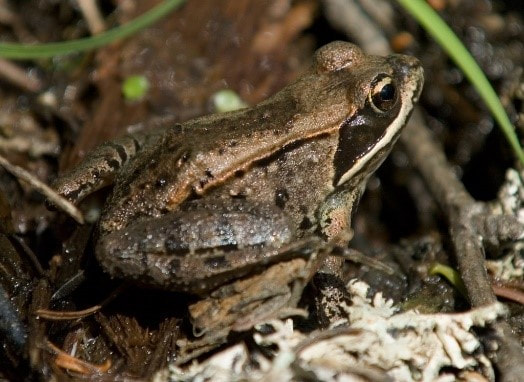
Wood frog (Lithobates sylvaticus) image used as reference for drawing. Image by Jamuudsen via Flickr.com. Labeled for noncommercial reuse.
|
While interpreting my art is difficult, the one aspect of my art that I’m proudest of, however, is my depictions of the amphibians. I used various internet photographs to ensure that my hand-drawn anurans and salamander were as life-like as possible without being immaculate. I’ve never tried drawing amphibians in a cartoon style either, and I successfully challenged myself to the task.
|
They’re not at all perfect representations for each species, but they are 80%+ correct – I’ll take that as a win and something to improve upon. It was definitely fun drawing them like this!
Overall, I think I accomplished my artwork goals, but there is work needed on this piece to make it a figure I could use in a presentation or poster. This is the first assignment, and I have a ton to learn and time to improve my ability to disseminate science via art.
While I did have goals that I think I met, including my cartoon-like design and anatomically-correct amphibians, I struggled on making the art clean and clear. All of my project’s components are there – even the DNA at the top! – but the lack of context, the cluster of details at the bottom, and the amphibian “paths” that connect the species to ponds ultimately made my piece hard to interpret. Unfortunately, I was too cryptic with my drawing! Next time, I’m going to use more text, and perhaps less “stuff”, to try and explain my science via drawing. I also might stick to one part of my research, rather than cram my entire PhD research’s work into one drawing.
Overall, I think I accomplished my artwork goals, but there is work needed on this piece to make it a figure I could use in a presentation or poster. This is the first assignment, and I have a ton to learn and time to improve my ability to disseminate science via art.

Boreal toad (Anaxyrus boreas boreas) used as a reference for this drawing. Image by J. N. Stuart via Flickr.com. Labeled for noncommercial reuse.
Thank you for reading, and stay tuned for more awesome art-science posts in the future!
Cheers,
Cheers,
~Mel
Twitter: @TorresAmphibs
Instagram: @tulatorres
 Engage Laramie Science