
today in many parts of the developing world.“

It’s Monday: Get back to work video games
Ok everyone, I want to see a show of hands— who here learned your multiplication tables by:
- Endless number of homework worksheets and hand cramps
- Their 2nd and 3rd grade teachers scowling and pondering on their desk
- Video games
Now which way would you have preferred to learn?
Speaking personally, this was by far the best multiplication teacher I ever had:
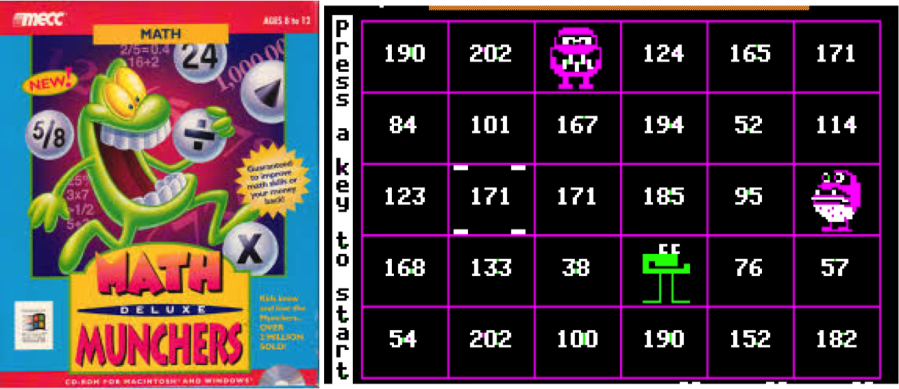
“Number Munchers” was a PC video game release in 1986, combining the addictiveness of Pac-Man and teaching. In this classic game, the only way you could move and escape the ghost was to answer the math questions as quick as possible. Got to move fast to beat your friend’s high score!
And hey it worked: I mastered my multiplication tables, and today I’m getting phD that’s all about doing lots of math on the computer and the scientific truths we learn from that math.
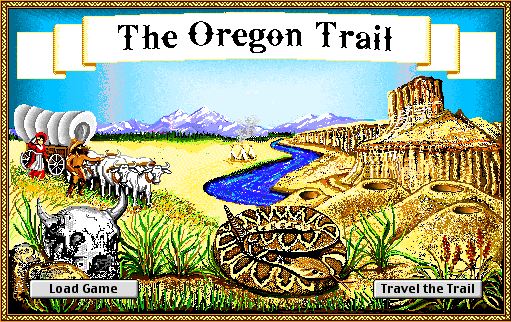
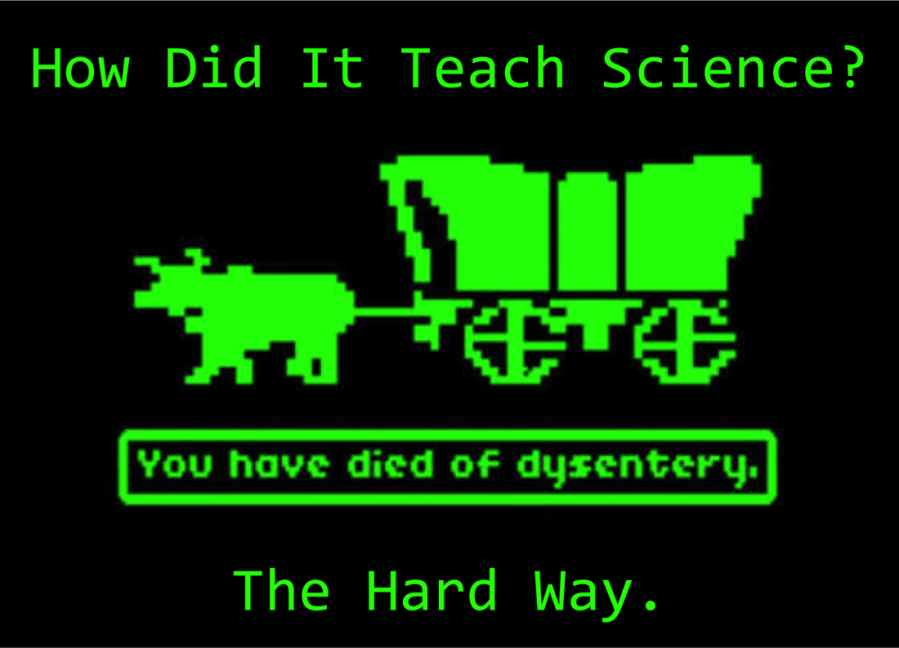
“The Oregon Trail” incorporated many science/health challenges that were a were experienced then and are still experienced today in many parts of the developing world.
Other aspects of science seen along the Trail are changing biomes: the player starts out in wooded eastern Missouri, travels through the western plains, over the rocky mountains, before reaching the Oregon coast. Climate, plants, and animals change over this gradient, bringing unique opportunities and challenges along the way.
The Oregon Trail was and is still a great game, having gone through many versions since it’s original 1977 release. In fact you can still download it today for PC and mobile platforms.
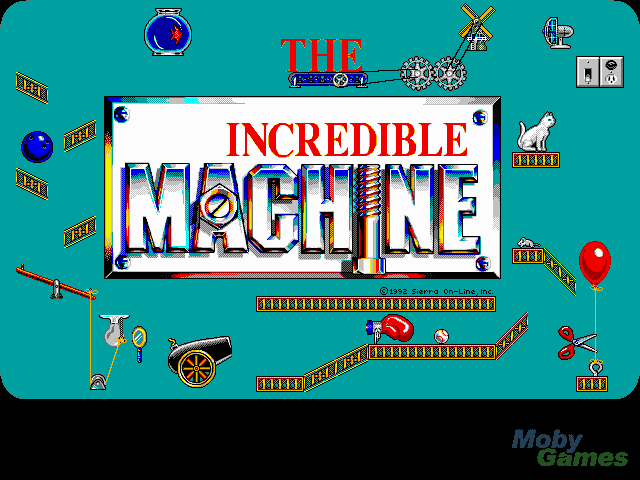

Now speeding along to the 21st century…. Technology has so changed the world. Video games are not just a dorky-side-show, but a mainstream of society with over 1.8 billion number of people playing some type of game everyday (1). And it’s not just playing video games directly, but even watching video games! Twitch, a website designed to watch other people play video games, has >100 million viewers every month (2) and is projected to have over a billion dollars in revenue (3). Prize pools for video game tournaments are larger than the Super Bowl (4)!
The technology transformation has also affected educational video games as well. In fact, there are entire markets of educational video games designed for TODDLERS!! As a parent… admittedly I have mixed feelings about this. Video games can be a great tool for relaxation and education, but need to be taken in moderation—don’t forget to also play outside!
One modern educational video game I need to do a shout out for is Colorado University’s https://earthgames.org. They have fun games to play, showing you the changes happening to our (un)natural world today.

Clearly there’s a ton of other educational games out there—more than I could ever highlight on single blog post. But…. What about all those other video games? You know, those ones designed to rot your brain with and turn you into a permanent couch fixture? Yeah, they exist too. But you’d be surprised to see how commentators can change even these games into great science lessons (while getting a laugh)! Check out this video about the popular first-person-shooter game “Overwatch”:
1) Entertainment Software Association (2015) http://www.theesa.com/wp-content/uploads/2015/04/ESA-Essential-Facts-2015.pdf
2) Twitch.tv (2017) https://www.twitch.tv/p/about/
3) Bloomberg business (2016) http://streamernews.tv/2016/03/18/bloomberg-business-twitch-revenue-projected-to-top-1-billion-by-2020/
4) https://www.polygon.com/2014/7/19/5918845/dota-2-international-2014-champions-money-winners
 Engage Laramie Science